
Listed on 
 Years active
 English (Arabic)
 Chinese Simplified - 中文 (简体)
 Chinese Traditional - 中文 (繁體)
 English
 Japanese - 日本語
 Korean - 한국어 (대한민국)
 Portuguese - Português
 Russian - Русский
 Spanish - Español
 Thai - ไทย

 English (India)

Don't have an account?
Register via AppHave an account?
Login 19/11/2026 - 07:59 UTC
The United States Dollar Index (USDX) climbed +0.22% to reach a fresh 19-month high near the 104.00 level, propelled by hawkish Federal Reserve rhetoric and resilient economic data. Minutes from the October FOMC policy meeting revealed that nearly all members view further rate hikes as justified due to persistent inflation risks, with a couple of policymakers—including Governor Christopher Waller—warning of a potentially larger 50-basis-point increase in December if inflation fails to cool. With 10-year Treasury yields holding firmly above 5%, CME FedWatch pricing shows markets nearly certain of back-to-back 25-basis-point rate hikes in December and January, alongside rising odds for another move in March.
Global commodity and energy markets faced diverging pressures as hawkish monetary policy collided with renewed geopolitical risks in the Middle East. Gold (XAU/USD) tumbled -2.80% to trade near $3,746—its lowest level since September 2025—as elevated Treasury yields and a surging dollar dampened demand for the non-yielding metal. Meanwhile, WTI Oil plunged -4.51% in the previous session before rebounding slightly above $82.00 early Thursday, as escalating U.S.-Iran hostilities, fresh maritime strikes in the Strait of Hormuz, and regional missile interceptions helped offset a larger-than-expected 3.38 million barrel build in U.S. crude inventories.
Asian equity markets traded mixed on Thursday, led lower by steep declines in Taiwan and Chinese internet shares as Anthropic's record IPO failed to calm broader anxieties surrounding the artificial intelligence trade. Major regional technology and semiconductor shares registered notable moves in the latest session, including Murata (+1.65%), SK Hynix (+1.57%), TDK (+0.59%), Kioxia (+0.12%), Samsung Electronics (+0.05%), and Advantest (-1.10%), while Chinese tech names retreated with Meituan (-3.91%), Baidu (-2.72%), Alibaba (-2.64%), and JD.com (-1.94%) closing lower. Separately, Australia's labor market weakened unexpectedly in October as the unemployment rate climbed to 4.9% following a sharp drop in employment.
U.S. equity markets closed mixed overnight as the main US equity indices diverged, with the Dow Jones Industrial Average falling while the Nasdaq Composite managed modest gains. Major corporate and technology names remained in focus as Nvidia reversed early gains to close lower despite strong quarterly results and guidance, while retailers Target and Walmart traded lower ahead of today's earnings slate. Market attention now turns squarely to Anthropic's historic Nasdaq debut under ticker ANT after the Claude developer priced its initial public offering above range at $83 per share, raising $81.3 billion in the largest IPO on record to surpass SpaceX's debut earlier this year.
Looking ahead, market participants are focused on corporate earnings and central bank commentary to gauge consumer health and rate expectations. Thursday features high-profile quarterly results from Walmart, PDD Holdings, and Intuit alongside Anthropic's first day of public trading, while investors continue to digest FOMC policy signals heading into the final stretch of the week.
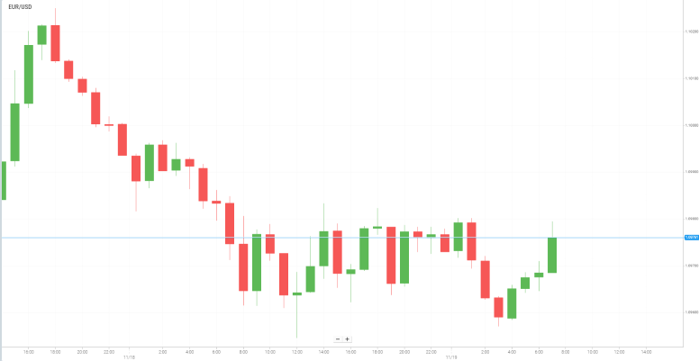
The EUR/USD currency pair remained largely unchanged, trading around 1.0980 during Thursday’s Asian session after recording modest losses the previous day. The Euro faced pressure as the US Dollar strengthened following increasingly hawkish signals from the Federal Reserve (Fed), reinforcing expectations of further interest rate increases in December.
The latest Fed Meeting Minutes revealed that policymakers generally agreed in October that additional rate hikes would be necessary to bring inflation under control, although they decided to pause temporarily to assess incoming economic data. Most officials supported further monetary tightening, with some even considering a potential 50-basis-point increase if inflation figures failed to improve.
Supporting this hawkish outlook, Fed Governor Christopher Waller indicated that the Federal Open Market Committee (FOMC) should consider a 50-basis-point rate hike in December. Other policymakers, including John Williams and Alberto Musalem, also suggested that tighter monetary policy could be necessary to control inflation.
Meanwhile, the CME FedWatch Tool indicates that markets are pricing in approximately a 90% probability of a 25-basis-point Fed rate hike in December, while the possibility of a larger 50-basis-point increase stands at around 10%.
On the Eurozone front, expectations of further monetary tightening by the European Central Bank (ECB) have strengthened following the latest inflation figures. Furthermore, geopolitical tensions in the Middle East remain a potential catalyst for currency market movements, as investors continue to assess their implications for global economic stability and demand for safe-haven currencies.
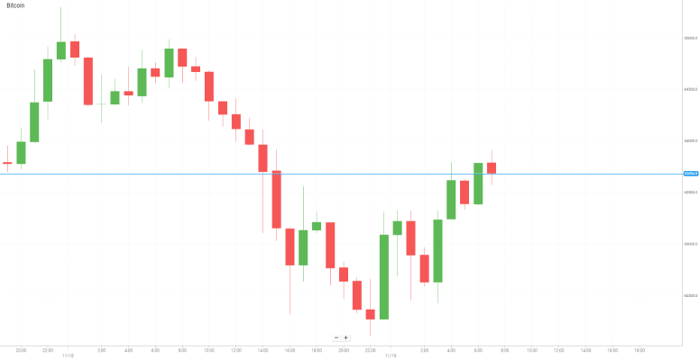
Bitcoin declined on Wednesday, remaining near a four-month low as growing expectations of a December US Federal Reserve interest rate hike weighed on investor appetite for riskier assets.
The broader sell-off in technology and artificial intelligence stocks further weakened market sentiment, keeping demand for cryptocurrencies under pressure. Meanwhile, anticipation surrounding Anthropic’s trading debut on Thursday added to shifting investment flows, with some investors moving away from cryptocurrency-related assets.
Bitcoin faced renewed selling pressure on Wednesday following a series of hawkish comments from Federal Reserve officials, which strengthened expectations of another interest rate increase in December. Minutes from the Fed’s late-October meeting revealed that a growing number of policymakers supported further monetary tightening, particularly as persistent inflation continued to raise concerns. Some officials even suggested that a larger 50-basis-point increase could be necessary. Adding to these concerns, Fed Governor Christopher Waller told CNBC that policymakers should consider a 50-basis-point rate hike in December, warning that inflation was moving in the wrong direction. Higher interest rates generally reduce the attractiveness of speculative investments such as Bitcoin by increasing the appeal of traditional interest-bearing assets.
The broader cryptocurrency market also remained under pressure on Thursday, with most major digital assets recording modest losses amid the ongoing sell-off that began in early October.
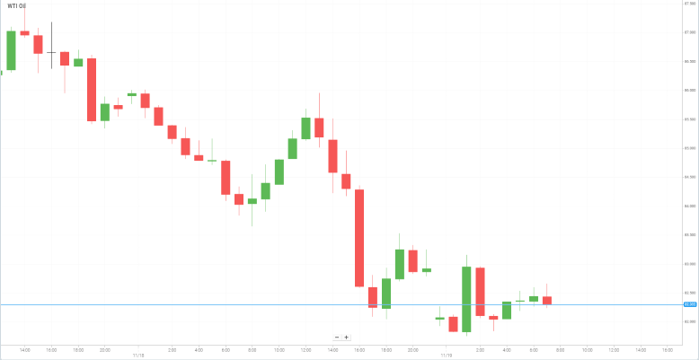
Oil prices remained relatively stable on Thursday following losses in the previous session, as expectations of a growing global supply surplus counterbalanced concerns over potential disruptions to Middle Eastern oil shipments amid escalating geopolitical tensions.
Oil prices had declined in the previous session, with WTI dropping to its lowest level since August 26. The declines were driven by expectations of a potential supply surplus as crude shipments through the Strait of Hormuz returned to approximately pre-war levels. Adding to the downward pressure, a larger-than-expected increase in US crude inventories raised concerns about weakening supply-demand fundamentals.
According to the US Energy Information Administration (EIA), crude oil inventories increased by 3.4 million barrels to 417.8 million barrels in the week ending November 13, significantly exceeding analysts’ expectations of a 58,000-barrel increase.
Nevertheless, geopolitical risks continue to provide support for oil prices. Reports from Iranian media indicated that three oil tankers sailing east of the Strait of Hormuz had been disabled by naval mines. Meanwhile, the Iran-aligned Houthi movement reportedly launched missiles towards Saudi Arabia’s capital, Riyadh, although Saudi Civil Defense later confirmed that the immediate threat had passed. Monetary policy expectations have also become an important factor influencing the oil market.
Market participants are also closely monitoring developments surrounding the ongoing US-Iran conflict and the possibility of a diplomatic resolution. The anticipated trilateral summit involving the leaders of the United States, China and Russia could provide further insight into geopolitical developments and their potential implications for global energy markets.
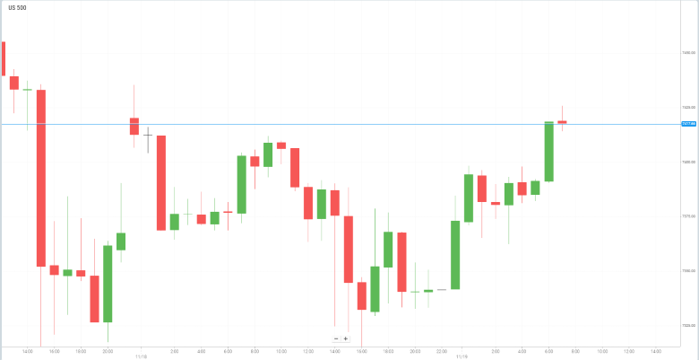
US stock futures climbed sharply early Thursday, with the US Tech 100 leading gains as Anthropic’s highly anticipated $1.5 trillion initial public offering (IPO) boosted investor optimism towards the artificial intelligence sector.
Investor sentiment improved after Anthropic priced its shares at $83 each, above its previously indicated range of $70–$78, ahead of its Nasdaq debut under the ticker symbol ANT. The company also increased the size of its offering to 980 million shares from the initially planned 825 million, reflecting strong investor demand. The IPO is expected to raise approximately $81 billion, potentially making it one of the largest public listings on record and surpassing SpaceX’s $75 billion debut earlier in the year.
The listing is being closely watched by investors as an important test of demand for artificial intelligence companies, particularly following recent losses in technology and semiconductor stocks that raised concerns about elevated valuations and the profitability of substantial AI infrastructure investments.
On Wednesday, Technology stocks remained under pressure despite stronger-than-expected quarterly results from Nvidia. The semiconductor giant reported better-than-anticipated earnings and issued an optimistic fourth-quarter revenue forecast. However, its shares declined as investors continued to assess uncertainty surrounding the company's leadership following co-founder Jensen Huang’s reported departure.
Monetary policy uncertainty remained another significant concern for investors. Minutes from the Federal Reserve’s October meeting indicated that policymakers remained worried about persistent inflation and were increasingly open to additional interest rate increases.
Among individual stocks, Target shares advanced after the retailer delivered an upbeat outlook for holiday sales. TJX Companies also recorded strong gains after forecasting better annual sales performance, suggesting that consumer demand could remain resilient heading into the holiday shopping season. Investors are now turning their attention to Walmart’s quarterly earnings report on Thursday for further indications of the strength of US consumer spending and the broader economic outlook.
The materials contained on this document should not in any way be construed, either explicitly or implicitly, directly or indirectly, as investment advice, recommendation or suggestion of an investment strategy with respect to a financial instrument, in any manner whatsoever. Any indication of past performance or simulated past performance included in this document is not a reliable indicator of future results. For the full disclaimer click here.
Join iFOREX to get an education package and start taking advantage of market opportunities.
 A beginner's e-book
 $5,000 practice demo account
 A 12-part video course
 Trusted partner

 Featured partner
 By


