
Listed on 
 Years active
 English (Arabic)
 Chinese Simplified - 中文 (简体)
 Chinese Traditional - 中文 (繁體)
 English
 Japanese - 日本語
 Korean - 한국어 (대한민국)
 Portuguese - Português
 Russian - Русский
 Spanish - Español
 Thai - ไทย
 English (India)
Don't have an account?
Register via AppHave an account?
Login 23/09/2026 - 07:04 UTC
The US Dollar Index (USDX) strengthened for a third straight session, rising 0.1% to near 100.70 during Asian trade on Wednesday marking a fresh high since late July. Support came as Fed officials reiterated a hawkish policy outlook following recent interest rate adjustments, with CME FedWatch tool odds pointing to nearly 90% expectations for another rate hike this year. Remarks from St. Louis Fed President Alberto Musalem, Chicago Fed President Austan Goolsbee, Richmond Fed President Tom Barkin, and Boston Fed President Susan Collins kept upside inflation risks in focus. However, persistent weakness in US treasury yields helped cap further greenback acceleration.
Gold remained under pressure on Wednesday, failing to sustain its earlier bounce as dollar strength and hawkish Fed rate expectations outweighed the tailwinds from lower bond yields. While geopolitical risk premiums from ongoing Middle East tensions provided a underlying floor, the precious metal slipped modestly, down 0.11% in its latest session.
WTI Crude Oil extended its losing streak to a fifth consecutive day, slipping 2.94% toward the $88.50 level amid reports of potential diplomatic progress between Washington and Tehran and Saudi Arabia’s efforts to restore Red Sea pipeline infrastructure. The ongoing efforts to unblock the strategic Strait of Hormuz further eased immediate global supply disruption concerns across global markets. However, ongoing US policy warnings regarding Iran and tighter aviation sanctions helped cushion further sharp downside.
Asian stock markets traded unevenly on Wednesday as caution prevailed ahead of Thursday’s high-stakes bilateral summit between US President Donald Trump and Chinese President Xi Jinping. Gains in South Korean equity benchmarks were countered by weakness across mainland Chinese and Hong Kong indices, where investors monitored Beijing's diplomatic boundaries on core trade and economic issues. Across major Asian technology names, performance for the latest trading session was mixed to positive: SK Hynix rose 0.99%, Samsung Electronics surged 2.53%, Baidu edged up 0.25%, JD.com added 0.37%, Alibaba gained 0.47%, while Tencent dropped 2.48%.
US equities took a breather after earlier megacap tech gains, with market attention centering on Meta’s Connect 2026 conference and rising interest in its newly launched autonomous AI agent, Muse. Investors evaluated how these agentic consumer software models might accelerate commercial AI integration across diverse business workflows. While CPU and semiconductor hardware providers maintained support from demand for agentic AI processing architectures, major US tech names saw mixed results in Tuesday's session: Meta slipped 0.61%, Intel gained 1.78%, and AMD rose 1.3%.
Looking ahead, market participants are watching preliminary September global PMI prints, upcoming speeches from FOMC members, developments surrounding the Meta Connect 2026 event, and the high-profile Trump-Xi summit scheduled for September 24. Trader focus will also turn toward corporate earnings results, including Costco Wholesale’s Q4 report scheduled for Thursday evening.
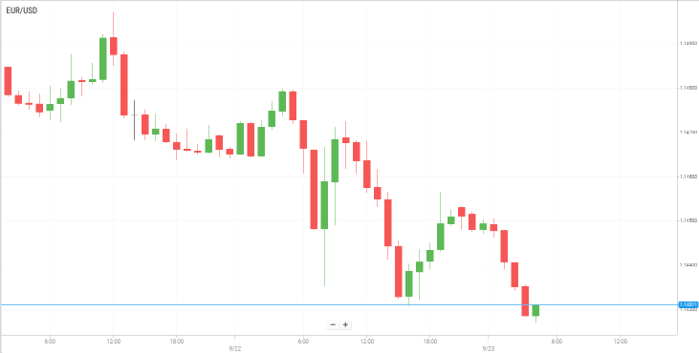
The EUR/USD pair weakened during Wednesday’s early Asian trading session as the US Dollar strengthened against the Euro. The decline came amid a more hawkish stance from the US Federal Reserve and growing expectations that additional interest rate hikes could be needed. Traders are now turning their attention to the preliminary Purchasing Managers’ Index (PMI) readings from Germany, the Eurozone, and the United States, which are due later on Wednesday.
Boston Fed President Susan Collins said on Tuesday that she supported the US central bank’s decision last week to raise interest rates, citing the risk that inflation could remain above the Fed’s 2% target. Collins also noted that she sees an increased likelihood of scenarios in which inflation remains notably above 2%. Earlier on Monday, St. Louis Fed President Alberto Musalem similarly indicated that further rate increases could be necessary to bring inflation back toward the Fed’s target.
Meanwhile, political developments in Germany are adding pressure to the Euro. The far-right Alternative for Germany (AfD) secured significant gains in a regional election, contributing to a major setback for Chancellor Friedrich Merz’s conservative coalition. Despite these headwinds, the Euro continues to receive some support from lower oil prices and favorable yield differentials.
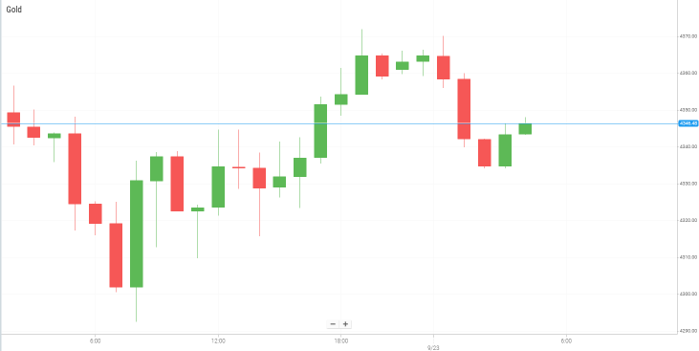
Gold came under renewed selling pressure on Wednesday after struggling to extend the previous day’s rebound from below the $4,300 level. The precious metal weakened during the Asian session as the US Dollar maintained its recent strength, supported by the Federal Reserve’s hawkish policy outlook.
The prospect of higher US interest rates, combined with ongoing geopolitical uncertainty, has supported demand for the US Dollar as a safe-haven asset. Developments surrounding tensions in the Middle East have added another layer of uncertainty. US President Donald Trump warned that he faces a major decision regarding Iran if the conflict remains unresolved, while new US sanctions targeting Iranian aviation are also coming into effect. At the same time, Iranian Foreign Minister Abbas Araghchi held discussions with US Special Envoy Steve Witkoff regarding Tehran’s conditions for reopening the Strait of Hormuz. Trump described the discussions as positive but provided few details. The uncertainty surrounding the situation continues to support the Dollar and limit demand for gold.
However, subdued US Treasury yields could help prevent a deeper decline in the precious metal. The recent decline in crude oil prices has eased concerns about a renewed surge in inflation, reducing some of the pressure on bond yields. Lower yields could eventually limit the Dollar’s upside and provide some support for gold.
Markets will now focus on the release of preliminary global Purchasing Managers’ Index (PMI) data, which could provide fresh clues about the health of major developed economies. Investors will also monitor speeches from Federal Reserve officials and developments in global geopolitical tensions for further direction. The main focus, however, is expected to remain on Thursday’s highly anticipated meeting between US President Donald Trump and Chinese President Xi Jinping, which could generate significant volatility across financial markets and provide a fresh catalyst for gold prices.
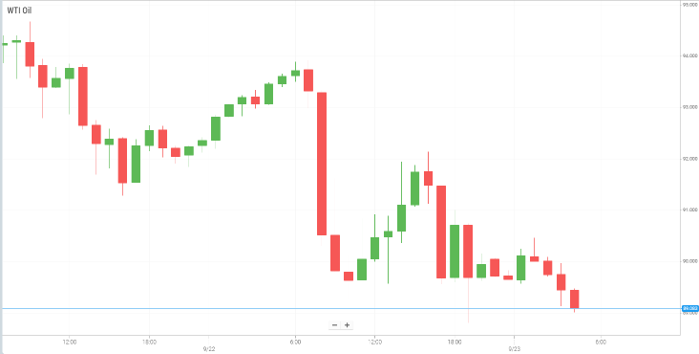
Oil prices edged lower on Wednesday as improving supply from the Gulf region and hopes for diplomatic progress between the United States and Iran eased some of the market’s recent concerns over potential disruptions.
Saudi Arabia has begun restoring operations on its East-West oil pipeline to the Red Sea, helping improve the outlook for regional crude flows. The pipeline had been shut after drone attacks forced Saudi Arabia to suspend operations on September 11 and halt crude loadings at the Yanbu port. The disruption had affected an important alternative route for transporting oil while flows through the Strait of Hormuz remained constrained.
Saudi Arabia has been using the pipeline to reroute around 4 million barrels of crude per day to Yanbu, equivalent to roughly 4% of global oil supply. The resumption of operations has therefore provided some relief to the market and contributed to the recent decline in oil prices.
At the same time, hopes for a diplomatic solution to the conflict between the United States and Iran have increased. Although US President Donald Trump warned that the US could take severe action against Iran if the conflict remains unresolved, he also said that his envoys, Steve Witkoff and Jared Kushner, had held productive discussions with mediators involved in negotiations with Tehran. Trump said there was significant momentum toward reaching a potential agreement, encouraging traders to price in the possibility of diplomatic progress despite continued tensions.Iraq is also increasing its oil exports. Iraqi Oil Minister Basim Mohammed said the country is currently exporting more than 3 million barrels per day and expects exports through Turkey to rise above 600,000 barrels per day.
Additional pressure on oil prices came from US inventory data. Industry figures showed that US crude inventories increased by 1.8 million barrels in the week ending September 18, contrary to expectations for a decline. Investors will now await the official weekly inventory report from the US Energy Information Administration for further clues about domestic supply and demand conditions.
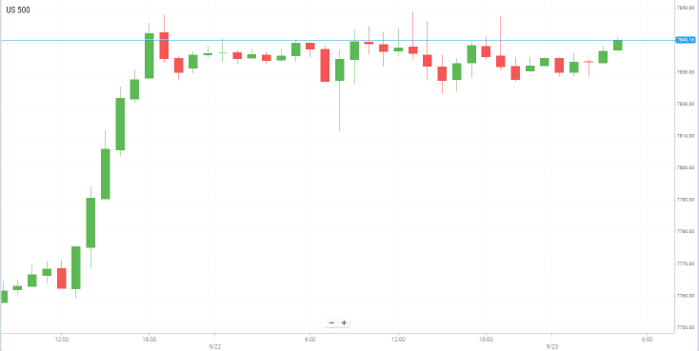
US stocks finished Tuesday’s session mixed, with the US 500 ending little changed as weakness in financial shares offset continued strength in technology stocks.
Investor attention remained focused on geopolitics as the United Nations General Assembly’s high-level debate got underway in New York. US President Donald Trump said during his speech that Washington and Tehran could reach an agreement after the US midterm elections in November. His comments came amid continued tensions between the two countries and ongoing uncertainty surrounding the conflict.
Technology stocks remained a key source of support for the broader market. Optimism surrounding Meta Platforms’ new Muse artificial intelligence model has helped revive interest in the AI trade, with investors focusing on the potential growth of consumer-facing AI agents capable of performing multi-step tasks autonomously. Meta shares had surged more than 11% on Monday following strong interest in Muse, while semiconductor stocks including AMD and Intel also benefited from expectations surrounding AI-related demand.
Investors are also looking ahead to Thursday’s meeting between Trump and Chinese President Xi Jinping in Washington. The discussions are expected to cover several issues, including artificial intelligence safety and the possibility of extending the temporary US-China trade truce, which is currently scheduled to expire in November. The meeting could therefore become an important source of market volatility as investors assess the direction of relations between the world’s two largest economies.
Overall, Wall Street ended the session with a mixed performance as investors balanced continued enthusiasm for artificial intelligence against weakness in financial stocks, falling oil prices and persistent geopolitical uncertainty. With the Trump-Xi meeting approaching and developments surrounding US-Iran relations continuing to influence markets, investors remain focused on geopolitical and trade developments alongside the ongoing strength of the technology sector.
The materials contained on this document should not in any way be construed, either explicitly or implicitly, directly or indirectly, as investment advice, recommendation or suggestion of an investment strategy with respect to a financial instrument, in any manner whatsoever. Any indication of past performance or simulated past performance included in this document is not a reliable indicator of future results. For the full disclaimer click here.
Join iFOREX to get an education package and start taking advantage of market opportunities.
 A beginner's e-book
 $5,000 practice demo account
 A 12-part video course
 Trusted partner
 Featured partner
 By
By 


