
Listed on 
 Years active
 English (Arabic)
 Chinese Simplified - 中文 (简体)
 Chinese Traditional - 中文 (繁體)
 English
 Japanese - 日本語
 Korean - 한국어 (대한민국)
 Portuguese - Português
 Russian - Русский
 Spanish - Español
 Thai - ไทย
 English (India)
Don't have an account?
Register via AppHave an account?
Login 24/09/2026 - 06:48 UTC
The US Dollar Index (USDX) extended its upward momentum, rising 0.59% to trade near eight-week highs above 101.00 during Thursday's Asian trade. Greenback demand was fortified by stronger-than-expected US flash PMI data, which signaled accelerating business activity and reinforced expectations for the Federal Reserve to maintain higher interest rates for longer. Market odds now point to a nearly 70% chance of an October Fed rate hike. Despite lingering safe-haven flows tied to Middle East tensions, elevated US Treasury yields pushed the 10-year yield toward 16-year highs, keeping the dollar firmly supported while capping broader risk appetite.
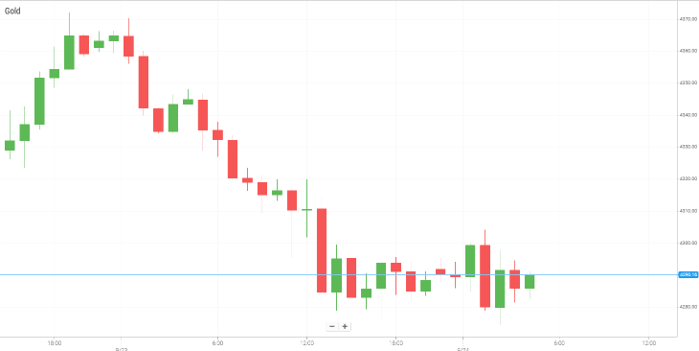
Gold remained heavily under pressure on Thursday, drifting toward a one-week low as robust US economic data and climbing bond yields reinforced the Fed's hawkish policy outlook. While elevated geopolitical risks between Washington and Tehran provided an underlying floor for safe-haven assets, persistent dollar strength outweighed these tailwinds, causing bullion to slip further below $4,300 with losses of 1.73% in its latest session.
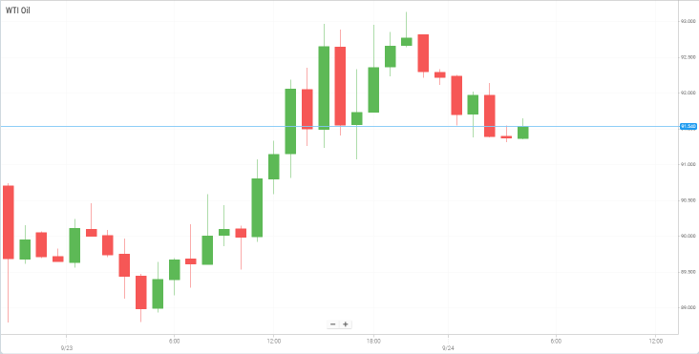
WTI Crude Oil snapped its five-day losing streak, rebounding 2.87% to trade back above the $92 level as diplomatic exchanges between the US and Iran at the UN General Assembly failed to produce an immediate breakthrough. Reopening negotiations around the strategic Strait of Hormuz hit hurdles as Tehran demanded an end to US maritime blockades, keeping global supply disruption concerns alive. Despite a larger-than-expected build in US crude inventories reported by the EIA and Saudi Arabia's efforts to restore pipeline capacity, lingering Middle East friction rekindled inflation fears and reignited upside momentum in energy markets.
Asian stock markets traded mostly lower on Thursday as surging global bond yields pressured risk assets ahead of the Washington summit between US President Donald Trump and Chinese President Xi Jinping. While investors digested trade truce extensions and potential progress on technology restrictions, losses across mainland Chinese and Hong Kong indices offset selective gains elsewhere. Across major Asian technology and mega-cap names, performance in the latest trading session was largely negative: SK Hynix rose 0.99%, Samsung Electronics gained 2.53%, Baidu dropped 2.92%, Alibaba fell 4.74%, and Tencent slipped 1.59%.
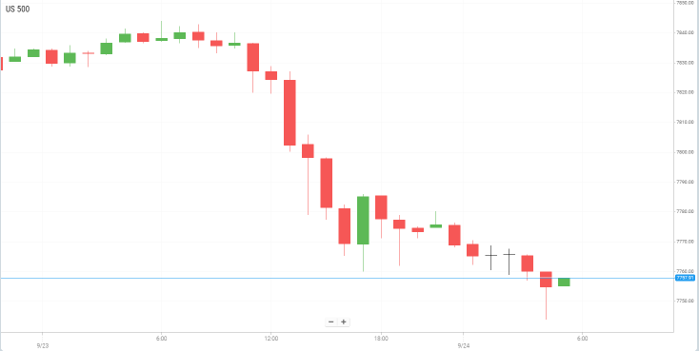
US equities pulled back from record highs as a sharp bond market sell-off and rising oil prices weighed on rate-sensitive growth sectors. Travel and consumer tech stocks took a notable hit, while broader market focus remained on Meta’s Connect 2026 conference and the rapid adoption of its autonomous AI agent, Muse. While agentic consumer software models continue to drive market interest, major US individual names posted mixed outcomes in their latest session: Meta gained 1.08%, while travel-related software providers faced sharp pullbacks, with Expedia dropping 7.78% and Airbnb declining 7.6%.
Looking ahead, market participants are keeping a close watch on incoming headlines from the high-profile Trump-Xi summit in Washington, ongoing updates from the Meta Connect 2026 conference, and the upcoming Reserve Bank of Australia interest rate decision on September 29. Trader focus will also remain tuned to global bond market volatility, shifting expectations surrounding future FOMC policy steps, and upcoming corporate earnings reports including Costco Wholesale's Q4 release.
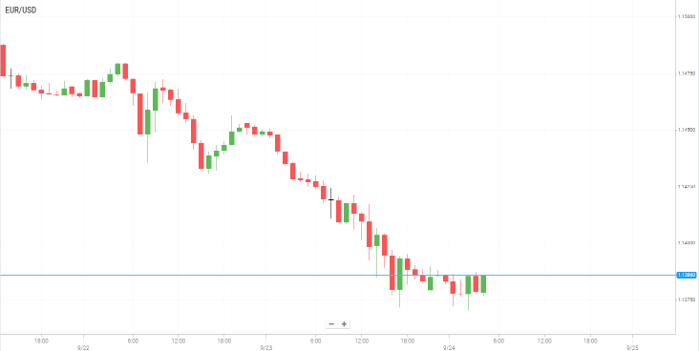
The EUR/USD pair declines toward 1.1380 during early Asian trading hours on Thursday, extending its recent losses as hawkish signals from the US Federal Reserve (Fed) support the US Dollar (USD) against the Euro (EUR). Market participants will focus on the US weekly Initial Jobless Claims report and further comments from Fed officials later in the day.
According to the preliminary reading of the US S&P Global Purchasing Managers’ Index (PMI), the Manufacturing PMI increased to 52.0 in September from 51.7 in August, exceeding market expectations of 51.4. Meanwhile, the Services PMI eased to 51.7 in September from 52.5 previously, falling short of the 52.0 consensus estimate. The Composite PMI also declined to 51.7 from 52.5 in the previous month.
On Wednesday, Federal Reserve Governor Michael Barr said that “further policy adjustments are likely to be needed” to bring inflation under control. Fed President Tom Barkin and Boston Fed President Susan Collins also supported the recent interest rate increase, pointing to persistent inflationary pressures.
In Europe, European Central Bank (ECB) policymaker Gabriel Makhlouf said the central bank could raise interest rates again if elevated energy prices begin to feed into prices across other sectors. However, he noted that there is currently no evidence of such second-round inflation effects.
Gold remains subdued below the $4,300 level after touching a one-week low during the Asian session on Thursday. The precious metal has so far struggled to attract sustained buying interest as traders await a closely watched meeting between US President Donald Trump and Chinese President Xi Jinping.
While markets are not expecting a major breakthrough from the meeting, investors will look for signs of progress on issues such as rare-earth exports, technology restrictions and a possible extension of the existing US-China trade truce. Any fresh headlines could nevertheless trigger volatility and provide some near-term direction for Gold prices.
Any recovery in Gold prices is likely to remain limited amid growing expectations that the US Federal Reserve (Fed) could raise interest rates again in October. Higher interest rates generally weigh on non-yielding assets such as Gold by increasing the opportunity cost of holding the precious metal.
Meanwhile, tensions between the United States and Iran remained in focus at the United Nations General Assembly (UNGA). US President Donald Trump said Iran faces a choice between diplomacy and what he described as total destruction.
Iranian President Masoud Pezeshkian responded that Tehran would not submit but remained open to a diplomatic solution. He also said that any agreement would need to include an end to the US blockade targeting Iranian ports and maritime shipping around the Strait of Hormuz.
Oil prices fell on Thursday after surging in the previous session, as Iran indicated that it remained open to diplomatic efforts to end its conflict with the United States. However, Tehran and Washington remain divided over the terms of any potential agreement.
A senior Iranian official told Reuters on Wednesday that Iran and the United States remained far apart on how to end the conflict, but said diplomatic efforts should continue. The comments came after Iranian President Masoud Pezeshkian told the United Nations General Assembly that Tehran would not surrender to US pressure.
The official said Iran was reviewing Washington's response to its peace proposals, which include demands for the lifting of a US naval blockade on Iranian ports and the reopening of the Strait of Hormuz.
US Secretary of State Marco Rubio said on Wednesday that reaching an agreement with Iran would require difficult negotiations over an extended period. He also said that US President Donald Trump continued to have military options available.
US distillate inventories, including diesel and heating oil, declined by 428,000 barrels to 107.4 million barrels last week, according to data from the Energy Information Administration (EIA). Meanwhile, US crude oil inventories increased by 3 million barrels to 426.4 million barrels. The build was significantly larger than the 641,000-barrel draw expected by analysts polled by Reuters.
The unexpected increase in US crude inventories, combined with signs of easing geopolitical risk, could provide some near-term downward pressure on oil prices. However, developments surrounding Iran, the Strait of Hormuz and US diplomatic efforts remain key drivers for the crude market.
US stocks finished lower on Wednesday as a sharp rise in Treasury yields pressured technology shares, while investors monitored developments in the US-Iran conflict and looked ahead to Chinese President Xi Jinping’s visit to Washington.
Market sentiment remained cautious ahead of Xi’s meeting with US President Donald Trump, with investors looking for signs of progress on trade, artificial intelligence, technology restrictions and China’s rare-earth exports. US Treasury prices came under heavy selling pressure after stronger economic data and hawkish comments from Federal Reserve officials boosted expectations for additional interest-rate increases.
The sharp increase in Treasury yields weighed particularly heavily on rate-sensitive sectors. The S&P 500 technology sector declined 0.7%, while travel-related stocks also weakened. The pullback followed two strong sessions for technology stocks, during which the Nasdaq Composite reached consecutive record closes as enthusiasm surrounding artificial intelligence returned to the market.
Meta Platforms remained a notable exception, with its shares rising 1% as investors focused on the company's AI developments. The company's new AI agent, Muse, has attracted significant consumer interest since its September 8 launch and has reportedly reached the top of Apple’s App Store among free applications.
Investors are now turning their attention to Xi Jinping’s visit to Washington and his meeting with Trump. Artificial intelligence is expected to be among the key topics, alongside trade, tariffs, rare-earth exports and agricultural purchases. The two countries are also expected to discuss the existing tariff truce, which is scheduled to expire in November.
The outcome of the meeting could influence market sentiment across equities, commodities and currencies, particularly as investors continue to assess the direction of US-China trade relations and the broader geopolitical environment.
The materials contained on this document should not in any way be construed, either explicitly or implicitly, directly or indirectly, as investment advice, recommendation or suggestion of an investment strategy with respect to a financial instrument, in any manner whatsoever. Any indication of past performance or simulated past performance included in this document is not a reliable indicator of future results. For the full disclaimer click here.
Join iFOREX to get an education package and start taking advantage of market opportunities.
 A beginner's e-book
 $5,000 practice demo account
 A 12-part video course
 Trusted partner
 Featured partner
 By
By 


