
Listed on 
 Years active
 English (Arabic)
 Chinese Simplified - 中文 (简体)
 Chinese Traditional - 中文 (繁體)
 English
 Japanese - 日本語
 Korean - 한국어 (대한민국)
 Portuguese - Português
 Russian - Русский
 Spanish - Español
 Thai - ไทย

 English (India)

Don't have an account?
Register via AppHave an account?
Login 29/10/2026 - 07:57 UTC
The United States Dollar Index (USDX) gathered strength during early European hours on Thursday, trading near 102.25 as the index moved down 0.22% overall following the Federal Reserve's October policy meeting. The Fed voted 10-2 to hold benchmark interest rates steady in the 3.75%–4.00% range, as widely expected, though Governors Lisa Cook and Beth Hammack dissented in favor of a 25-basis-point hike. While CME FedWatch tool pricing reflects an 83.3% probability of a December rate increase, Greenback gains were capped after Fed Chair Kevin Warsh offered no explicit forward guidance during his press conference, acknowledging that price stability had not yet been achieved.
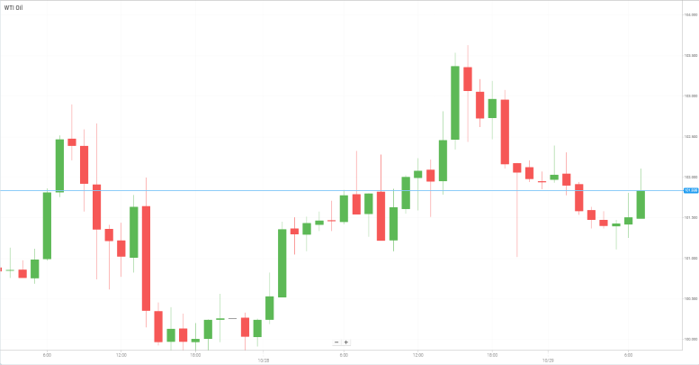
Global commodity markets traded with a cautious bias as investors monitored ongoing diplomatic efforts alongside heightened Middle Eastern supply risks. West Texas Intermediate (WTI Oil) drifted lower toward mid-$100.00s per barrel before climbing near $101.20 in early Asian hours, recording a net gain of 1.25% as losses were constrained by renewed regional supply fears. Recent Houthi missile and drone strikes targeting Saudi Arabia's Ras Tanura oil refinery and Aden airport, alongside potential post-midterm U.S. military action against Iran, kept geopolitical risk premiums intact despite Qatari and U.S. diplomatic attempts to restart peace talks. Gold (XAU/USD) edged down 0.21% on Thursday, remaining subdued as recovering U.S. Treasury yields and firming December Fed hike bets continued to weigh on non-yielding bullion.
Asian stock markets turned lower on Thursday, surrendering earlier gains as disappointing corporate results and semiconductor margin pressures weighed on sentiment. South Korea's KOSPI fell nearly 3%, driven by a 4.12% drop in Samsung Electronics despite record Q3 profit, as investors reacted to missed semiconductor profit expectations and elevated capital expenditure forecasts. Conversely, SK Hynix advanced 1.69% in Seoul after delivering blowout quarterly results and announcing a 100 trillion won ($75 billion) shareholder-return plan. In Japan, the Nikkei 225 erased early gains to trade flat to lower as market participants awaited Friday's Bank of Japan rate decision, while Chinese benchmarks fell over 1% led by chipmaker losses.
U.S. equity markets ended slightly higher in Wednesday's cash session following the Fed's rate pause and blowout earnings from memory chipmaker SK Hynix. In the regular session, Microsoft gained 0.18%, Alphabet rose 1.67%, and Nvidia fell 1.18%. However, Wall Street index futures retreated sharply early Thursday, with Nasdaq 100 futures moving lower. Technology sentiment was severely hit after-hours by Alphabet's Q3 results; despite revenue rising 25% to $127.6 billion, the company missed EPS estimates ($2.12 vs $3.02 expected) due to an $8.7 billion loss on equity securities and surging AI infrastructure expenses, causing its shares to tumble over 8.5% in extended trading.
Looking ahead, market participants are bracing for a high-impact slate of economic data, central bank events, and corporate earnings releases. Today, traders will track key U.S. macro data including Advance Q3 GDP (expected at 3.2% q/q), Core PCE Price Index m/m (expected at 0.3%), Advance GDP Price Index (expected at 3.2%), and Weekly Unemployment Claims (expected at 198K). Central bank focus shifts to Europe for the European Central Bank (ECB) Main Refinancing Rate decision (expected to hold at 2.65%), Monetary Policy Statement, and Press Conference with President Christine Lagarde. On the earnings front, quarterly reports are due from Amazon (AMZN, EPS est. $1.96, Rev est. $202.1B), Eli Lilly (LLY, EPS est. $5.60, Rev est. $22.42B), Mastercard (MA, EPS est. $5.16, Rev est. $9.65B), Intel, and SanDisk. Tomorrow, attention turns to Japan's Tokyo Core CPI (expected at 2.6% y/y) and the Bank of Japan Policy Rate announcement
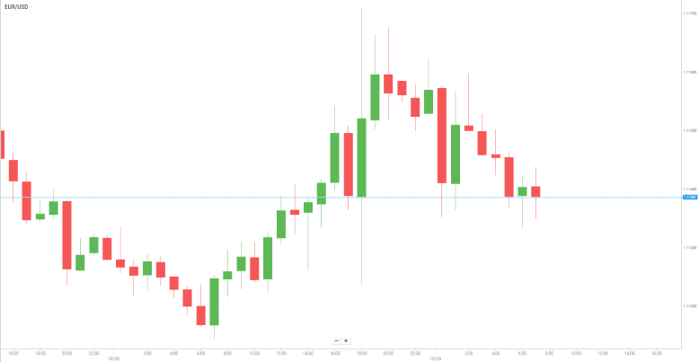
The Euro remains under pressure ahead of Thursday’s European Central Bank (ECB) monetary policy decision, with policymakers widely expected to keep the deposit rate unchanged at 2.50%. However, persistent energy-driven inflationary pressures continue to fuel speculation about a possible rate hike in December, keeping investors focused on the central bank’s assessment of inflation, economic growth, and the future direction of monetary policy.
The pair declines as the US Dollar (USD) recovers from its previous losses following the Federal Reserve’s decision to maintain interest rates within the 3.75%–4.00% range. The Federal Reserve justified its decision by pointing to continued economic expansion, resilient domestic spending, strong capital investment, and robust productivity growth. Regarding the labor market, the central bank noted that job gains have remained broadly in line with workforce growth, while the unemployment rate has changed little.
Although the Fed acknowledged that inflationary pressures remain elevated, policymakers opted to maintain the current interest rate range while assessing incoming economic data and determining the appropriate monetary policy stance. The decision was not unanimous, with Fed Governor Lisa Cook and Cleveland Fed President Beth Hammack dissenting in favor of an immediate rate increase.
Meanwhile, the Euro faces additional pressure as markets anticipate that the ECB will leave its deposit rate unchanged at 2.50% at Thursday’s meeting, following a cumulative 50 basis points in rate increases earlier in the year. Nevertheless, persistent energy-related inflation risks have kept expectations of a potential December rate hike alive among investors.
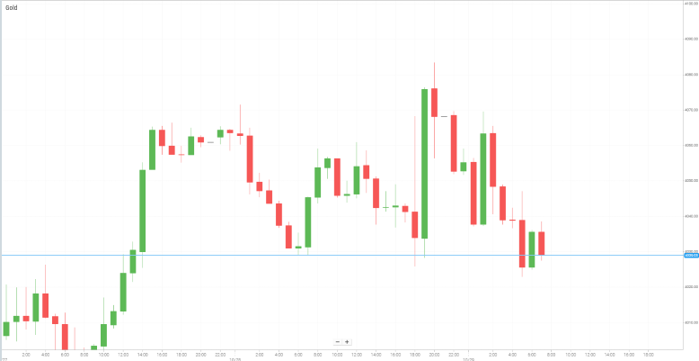
Gold remains under bearish pressure on Thursday as renewed demand for the US Dollar (USD) weighs on the precious metal. Although Gold has recovered modestly from its daily low, it continues to trade below the $4,050 level during the early European session, reflecting persistent downside pressure amid expectations of further monetary tightening by the Federal Reserve (Fed).
The US Dollar attracts fresh buying interest after correcting lower from a two-week high following Wednesday’s Federal Open Market Committee (FOMC) decision. The Fed kept interest rates unchanged at its October meeting in a 10–2 vote, with Governor Lisa Cook and Cleveland Fed President Beth Hammack dissenting in favor of a 25-basis-point rate increase.
Geopolitical developments also contribute to demand for the safe-haven US Dollar. Concerns over a potential escalation of tensions between the United States and Iran have intensified following reports that US officials urged several Gulf Arab countries to prepare for a possible military campaign against Iran after the November 3 midterm elections. Iranian Foreign Minister Abbas Araghchi has reiterated the country’s readiness to defend itself while maintaining communication with intermediaries to preserve the possibility of diplomatic negotiations. Meanwhile, regional mediators, including Qatar, are working to revive discussions between Washington and Tehran to prevent renewed conflict. Reports of a letter from US Vice President JD Vance to Iranian official Mohsen Rezaei have also raised hopes of renewed diplomatic engagement.
Looking ahead, traders are likely to remain cautious ahead of the release of the US advance third-quarter Gross Domestic Product (GDP) report and the Personal Consumption Expenditures (PCE) Price Index, the Federal Reserve’s preferred inflation gauge. These reports could provide fresh insight into the strength of the US economy and the persistence of inflation, potentially influencing expectations for the Fed’s December policy decision.
Oil prices declined on Thursday, giving back part of the previous session’s gains as renewed hopes for diplomatic negotiations eased concerns over potential supply disruptions stemming from escalating tensions in the Middle East.
Market sentiment improved after reports that US Vice President JD Vance had sent a letter to Iranian Security Council chief Mohsen Rezaei in an effort to revive peace negotiations. According to the Wall Street Journal, the communication was intended to encourage renewed diplomatic engagement between Washington and Tehran.
Despite the diplomatic developments, significant geopolitical risks continue to support crude prices. Concerns persist that the United States could launch military action against Iran following the November 3 midterm elections, while intensified attacks involving Yemen’s Houthi movement have heightened fears of further disruptions to regional energy supplies.
Additional pressure on oil prices came from expectations of a recovery in Russian crude production and refining activity. JPMorgan analysts noted that no further confirmed attacks on Russian refining infrastructure had been reported since the October 15 strike on the Ryazan refinery.
Meanwhile, the latest US inventory data offered a mixed signal for the oil market. The US Energy Information Administration reported that crude oil inventories declined by 1.9 million barrels in the week ended October 23, compared with analysts’ expectations for an increase of 15,000 barrels. The larger-than-expected drawdown suggested underlying demand for crude remained supportive. However, gasoline inventories increased by 3.9 million barrels, sharply contrasting with market expectations for a decline of 900,000 barrels and potentially indicating softer demand for refined fuels.
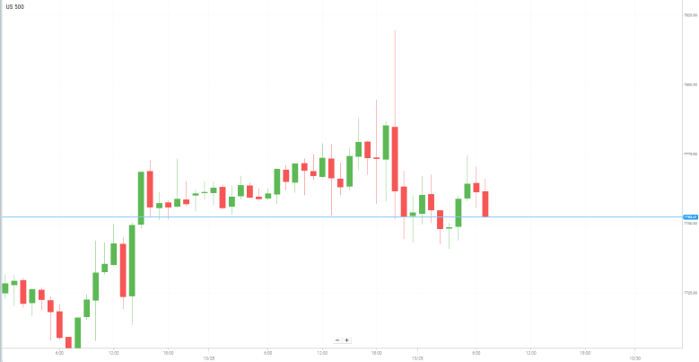
Wall Street closed modestly higher on Wednesday after the Federal Reserve (Fed) kept interest rates unchanged, as widely expected, while investors assessed the outlook for monetary policy and awaited quarterly earnings from major technology companies.
Market sentiment was supported by stronger-than-expected earnings from South Korean memory chipmaker SK Hynix, which helped revive demand for semiconductor shares. However, US stock futures fell early on Thursday, pressured by a sharp decline in Alphabet following a significant earnings miss, while Microsoft advanced after reporting better-than-expected quarterly results.
Concerns over the substantial spending commitments associated with artificial intelligence (AI) infrastructure remained in focus. Alphabet’s profitability was weighed down by continued investment in AI and data centers, reinforcing investor concerns about whether these expenditures will generate sufficient returns. Meanwhile, Microsoft’s stronger Azure growth provided a more positive signal regarding its ability to monetize AI investments.
The Fed’s policy outlook also remained a key market driver. Although rates were left unchanged at 4.0%, two policymakers supported a 25-basis-point increase. Chair Kevin Warsh’s comments on economic resilience and persistent inflation were interpreted as hawkish, pushing the 10-year Treasury yield above 5% and increasing expectations of a potential rate hike in December.
Looking ahead, US GDP and PCE inflation data, alongside further quarterly earnings from major technology companies, including Amazon, are likely to shape near-term market direction.
The materials contained on this document should not in any way be construed, either explicitly or implicitly, directly or indirectly, as investment advice, recommendation or suggestion of an investment strategy with respect to a financial instrument, in any manner whatsoever. Any indication of past performance or simulated past performance included in this document is not a reliable indicator of future results. For the full disclaimer click here.
Join iFOREX to get an education package and start taking advantage of market opportunities.
 A beginner's e-book
 $5,000 practice demo account
 A 12-part video course
 Trusted partner

 Featured partner
 By


