
Listed on 
 Years active
 English (Arabic)
 Chinese Simplified - 中文 (简体)
 Chinese Traditional - 中文 (繁體)
 English
 Japanese - 日本語
 Korean - 한국어 (대한민국)
 Portuguese - Português
 Russian - Русский
 Spanish - Español
 Thai - ไทย
 English (India)
Don't have an account?
Register via AppHave an account?
Login 10/09/2026 - 06:55 UTC
The U.S. Dollar Index (USDX) extended its decline for a third consecutive session on Wednesday, dropping 0.19% as it touched a near three-week low near its August swing low. The Greenback remains under pressure primarily from a surging Japanese Yen following hawkish signals from the Bank of Japan, as traders position ahead of crucial U.S. Producer Price Index (PPI) and Consumer Price Index (CPI) reports due Thursday and Friday to gauge the Federal Reserve's rate path. However, downside momentum for the safe-haven dollar could be restrained as robust U.S. Nonfarm Payrolls data and rising energy prices continue to bolster expectations for a potential Fed rate hike at the September meeting.
Gold prices rebound to reclaim the $4,400 mark, advancing 1.65% on Wednesday amid a weaker U.S. Dollar. However, upside momentum remains capped below $4,450 as hawkish rate expectations from the Fed, ECB, and BoJ pressure the non-yielding asset. While Middle East tensions and strikes near Kharg Island offer an underlying safe-haven bid, traders stay cautious ahead of key U.S. inflation data.
WTI crude oil experienced volatile trading, touching a fresh three-month top near $92.50 per barrel before easing slightly below $92.00, ultimately gaining 2.25% on Wednesday to build on last week's explosive rally. Energy markets remain defined by severe geopolitical risk premiums after the U.S. attacked Iranian tankers near Kharg Island and Iran responded by launching over 30 missiles at U.S. forces in Jordan while threatening full blockades and strikes on Gulf energy infrastructure. Tensions near the critical Strait of Hormuz waterway remain acute, further compounded by recent strikes near Saudi Aramco facilities and Houthi attacks on Saudi cities. Tight domestic inventory levels in the U.S., where gasoline and distillate stocks sit substantially below historical averages continue to reinforce global supply constraints despite steady export flows from the Persian Gulf, pushing Brent crude toward $100 per barrel.
Asian equity markets delivered a mixed session on Wednesday as ongoing enthusiasm for artificial intelligence hardware provided strong support to South Korean semiconductor heavyweights, with Samsung Electronics falling -0.18%, SK Hynix gaining 0.07%, while Murata Manufacturing surged 4.13%, Kioxia added 1.47%, and SoftBank Group advanced 0.86%. Broader regional indices moved mixed—with South Korea's KOSPI gaining over 1%, Japan's Nikkei 225 advancing slightly, and Hong Kong's Hang Seng falling moderately—tempered by rising energy costs and firm sovereign yield curves.
Momentum across the AI hardware ecosystem gained further backing after OpenAI's GPT-6 Astra launch reignited demand expectations. Meanwhile, economic data showed second-quarter GDP beating expectations in South Korea with a 0.6% expansion and growing at an annualized 1.4% in Japan, alongside accelerating August inflation metrics out of China with CPI up 0.8% year-on-year. In Chinese technology space, broader internet names reflected divergent performance with Alibaba sliding -2.88%, Baidu dropping -0.61%, Tencent declining -2.25%, and Xiaomi falling -2.05%.
U.S. equity futures and technology shares showed resilience as AGI developments anchored sentiment despite software sector weakness. Outside the scope of Middle East hostilities, Apple shares hit an intraday bottom after the tech powerhouse revealed a folding device at its annual showcase, marking its first fundamental design pivot since 2007. Designated the iPhone Duo, the base configuration is set at $1,999, establishing it as the brand's highest-priced handset to date. Initial orders open October 16 prior to an October 23 general release. The presentation also featured the upgraded iPhone 18 Pro and Pro Max carrying an AI-enhanced Siri feature set. Equity markets saw the stock claw back initial losses to finish Wednesday down -0.34%. Meanwhile, Nvidia fell -1.05% despite leadership citing OpenAI's GPT-6 Astra model as a driver for massive Grace Blackwell deployment demand.
Key upcoming macroeconomic catalysts and global events for the remainder of the week include high-profile U.S. corporate earnings from Oracle and Adobe on Thursday, September 10, followed by Kroger on Friday, September 11. Central bank operations take center stage on Thursday with the European Central Bank's interest rate decision and policy conference, alongside the U.S. PPI report. Friday's schedule features UK monthly GDP data alongside the critical U.S. CPI release.
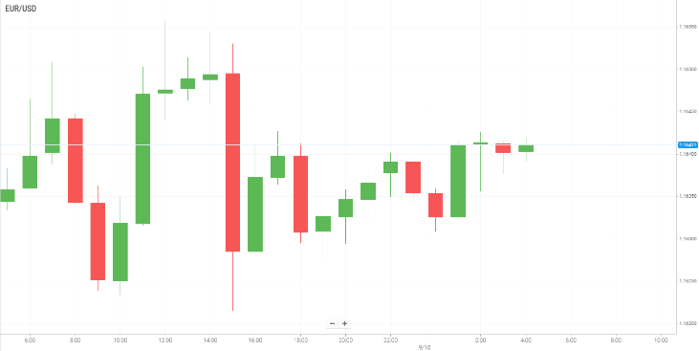
EUR/USD was little changed around 1.1635 in early Asian trading on Thursday, as investors remained cautious ahead of the European Central Bank’s (ECB) September policy decision and the release of key US inflation data later in the day.
The ECB is widely expected to raise interest rates by 25 basis points to 2.50%, marking its second hike of the year. Renewed energy price pressures and Eurozone inflation rising above 3% in August have strengthened expectations for further monetary tightening. Markets have also priced in another 25-basis-point increase by December, keeping the euro supported.
Attention will then turn to the US Producer Price Index (PPI) for August. Headline PPI is expected to accelerate to 5.3% year-on-year from 4.7%, while core PPI is forecast to rise to 4.6% from 4.2%. A stronger-than-expected reading could reinforce expectations for tighter US monetary policy and provide support for the US dollar, potentially limiting EUR/USD gains.
Investors expects Thursday’s rate increase to be accompanied by a hawkish tone from ECB President Christine Lagarde, particularly as the central bank updates its economic forecasts and highlights persistent upside risks to inflation.
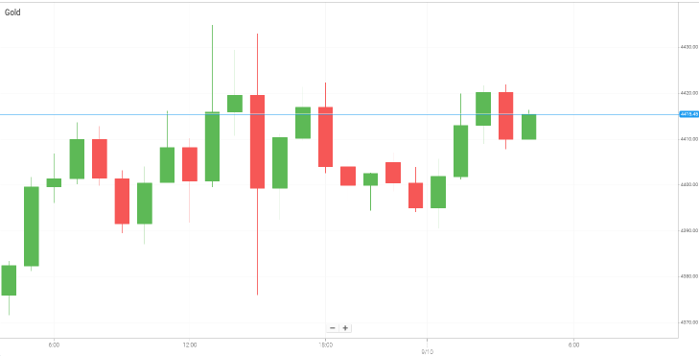
Gold prices recovered to around $4,400 in early Asian trading on Thursday as the US Dollar weakened. The precious metal remains highly sensitive to incoming economic data, with traders awaiting the latest US inflation figures for clues about the Federal Reserve’s policy outlook.
Renewed tensions in the Middle East and higher oil prices have added to inflation concerns, increasing expectations that the Fed could maintain a tighter policy stance at next week’s meeting.
Markets are currently pricing in roughly a 60% probability of a rate hike, according to the CME FedWatch Tool. Higher interest rates tend to pressure gold by increasing the appeal of yield-bearing assets.
The focus now turns to Thursday’s US Producer Price Index (PPI), followed by Friday’s Consumer Price Index (CPI). A stronger-than-expected inflation reading could reinforce expectations for tighter Fed policy and weigh on gold, while softer data could ease rate concerns and provide further support for the precious metal.
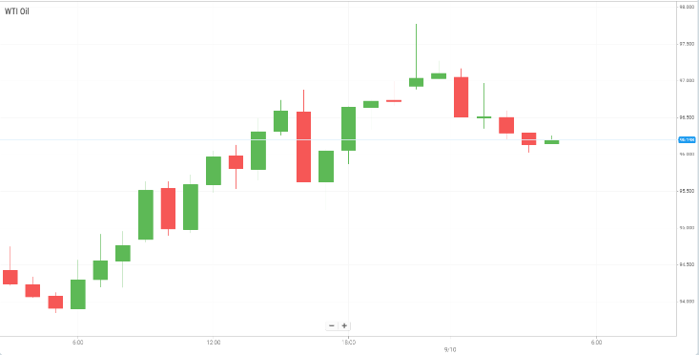
Oil prices remained elevated on Thursday after Brent crude broke above $100 a barrel, as escalating attacks between the US and Iran raised concerns over further disruptions to global supplies.
Brent has gained nearly 30% from its early-August lows as hopes for a lasting US-Iran ceasefire faded and fighting intensified again.
Iran said it had attacked 10 ships near the Strait of Hormuz after the US sank five Iranian oil tankers, while Iran’s Islamic Revolutionary Guard Corps warned that its response could escalate. The developments have raised fears that crude flows through the key waterway will remain disrupted for an extended period.
The Strait of Hormuz previously handled roughly one-fifth of global oil and gas supplies, but flows have fallen sharply since the conflict began. Meanwhile, increased attacks by Iran-aligned Houthi militants against Saudi Arabia are adding pressure to alternative export routes through the Red Sea.
With uncertainty surrounding actual supply volumes and continued shipping disruptions, physical oil markets remain tight and geopolitical risk is keeping a premium in crude prices. The US Energy Information Administration also raised its oil price forecasts for this year and next, citing tighter global inventories following the loss of Middle Eastern supply.
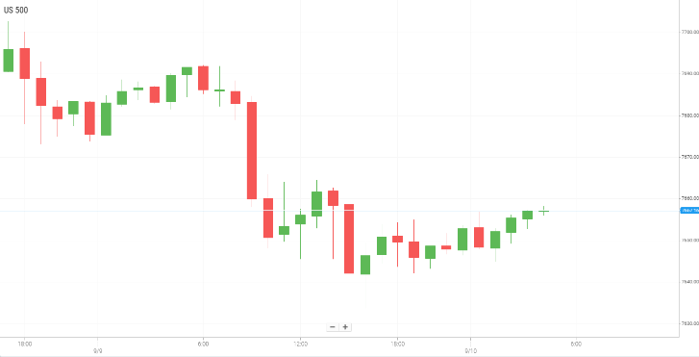
US stocks ended lower on Wednesday as a disappointing Treasury buyback announcement triggered a sharp rise in bond yields, while Brent crude climbed above $100 a barrel for the first time since late May. Investors also remained cautious ahead of key US inflation data that could influence expectations for the Federal Reserve’s September policy decision.
The bond sell-off reflects broader concerns over persistent inflation, elevated oil prices, heavy government borrowing and rising corporate debt issuance linked to artificial intelligence investment.
Markets are now focused on Thursday’s August PPI and Friday’s CPI reports. A stronger-than-expected inflation reading could further increase expectations for a Fed rate hike on September 16, with the probability currently around 60%, according to the CME FedWatch Tool.
Meanwhile, Apple shares ended 0.3% lower after recovering from deeper losses following the company’s product launch. Apple unveiled its first foldable iPhone, the iPhone Duo, starting at $1,999, alongside the iPhone 18 Pro and Pro Max models.
The materials contained on this document should not in any way be construed, either explicitly or implicitly, directly or indirectly, as investment advice, recommendation or suggestion of an investment strategy with respect to a financial instrument, in any manner whatsoever. Any indication of past performance or simulated past performance included in this document is not a reliable indicator of future results. For the full disclaimer click here.
Join iFOREX to get an education package and start taking advantage of market opportunities.
 A beginner's e-book
 $5,000 practice demo account
 A 12-part video course
 Trusted partner
 Featured partner
 By
By 


