
Listed on 
 Years active
 English (Arabic)
 Chinese Simplified - 中文 (简体)
 Chinese Traditional - 中文 (繁體)
 English
 Japanese - 日本語
 Korean - 한국어 (대한민국)
 Portuguese - Português
 Russian - Русский
 Spanish - Español
 Thai - ไทย
 English (India)
Don't have an account?
Register via AppHave an account?
Login 11/09/2026 - 07:11 UTC
The U.S. Dollar Index (USDX) maintained its upward momentum on Thursday, advancing 0.28% to trade above the 99.12 level. The dollar's strength was directly bolstered by the hotter-than-expected PPI print, which drove market expectations for a Federal Reserve rate hike at the upcoming policy meeting above 70%. Higher core wholesale price growth of 4.6% year-over-year reinforced bets that persistent inflation pressures will compel the central bank to keep monetary policy tight.
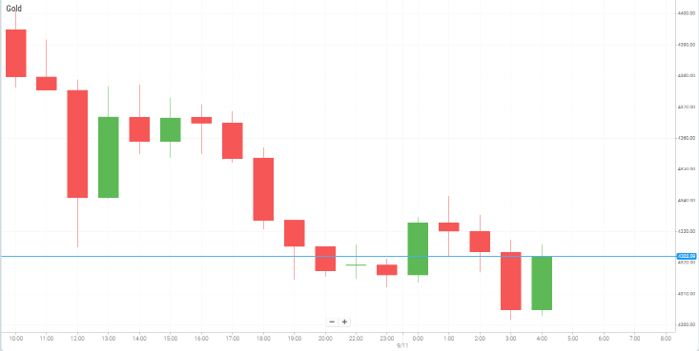
In precious metals, gold experienced downside pressure on Thursday, sliding -1.8% to bounce near the $4,300 mark as stronger wholesale inflation figures lifted rate-hike expectations. The U.S. Producer Price Index (PPI) accelerated to a 5.4% year-over-year rate in August, exceeding forecasts of 5.3% and boosting the Federal Reserve's hawkish outlook. Elevated energy costs and broader geopolitical tensions continue to bolster safe-haven demand, yet higher Treasury yield expectations and a firmer Greenback continue to limit bullion's immediate upside potential.
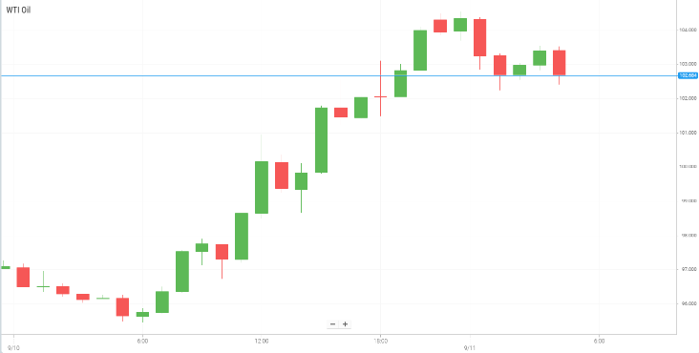
West Texas Intermediate (WTI) crude dropped back toward $98.50 per barrel during early European trading as market participants engaged in profit-taking following a sharp weekly rally of 7.46% through Thursday. The pullback was further influenced by Energy Information Administration data showing a smaller-than-anticipated draw in U.S. crude stockpiles of 391,000 barrels, compared to market forecasts of a 1.6 million barrel decline. Despite the temporary dip, oil markets remain supported by severe geopolitical risk premiums after Iran's Islamic Revolutionary Guard Corps targeted a U.S. unmanned vessel in the Strait of Hormuz. Supply disruption fears were further heightened as Houthi forces seized control of Mocha, expanding their influence over the strategic Bab al-Mandeb Strait, while U.S. President Donald Trump indicated that conflict in the region could persist beyond the November midterm elections.
Asian equity markets endured a severe selloff on Friday, as soaring crude oil prices and spiking global bond yields triggered a broad risk-off wave that overwhelmed ongoing enthusiasm surrounding artificial intelligence (AI) hardware. Broad regional benchmarks posted sharp declines, with Japan's Nikkei 225, South Korea's KOSPI, Chinese mainland indices, and Hong Kong's Hang Seng all sliding significantly.
Semiconductor and technology heavyweights bore the brunt of the risk-off pivot as macro headwinds eclipsed recent industry tailwinds. South Korean chipmakers extended losses, with Samsung Electronics declining -3.69% and SK Hynix dropping -2.56%. In Japan, Kioxia tumbled -5.73%, SoftBank Group fell -3.77%, and Murata Manufacturing slipped -1.07%, while Sony managed a slight gain of 0.13%. Chinese tech and internet majors similarly reflected the risk-off backdrop, with Baidu down -1.55% and Alibaba slipping -0.81%, even as Xiaomi bucked the trend to advance 1.65%.
U.S. technology and mega-cap hardware names also traded lower under pressure from elevated borrowing costs, as the U.S. 10-year Treasury yield neared 5%. In the chip and enterprise infrastructure ecosystem, Nvidia fell -2.41%, Broadcom slipped -0.92%, and Oracle dropped -5.36% during regular market trading, though Oracle bounced in extended hours following stronger-than-projected fiscal Q1 cloud growth and a record $664 billion backlog. The global macro backdrop continues to be dominated by energy market shocks, with Brent crude surging toward $108 a barrel amid acute supply disruption fears across the Strait of Hormuz and the Bab al-Mandeb Strait.
Looking at the remaining macroeconomic catalysts and earnings for the week, market focus turns heavily toward the U.S. Consumer Price Index release. Consensus estimates project monthly Core CPI to remain steady at 0.2%, while annual Core CPI is expected to moderate slightly to 2.4% from 2.5% previously. On the corporate front, retail giant Kroger headlines Friday's earnings calendar as investors digest its Q2 financial results.
EUR/USD remained largely unchanged around 1.1610 in early Asian trading on Friday as investors digested the European Central Bank’s latest policy decision and looked ahead to key US inflation data.
The ECB raised its deposit rate by 25 basis points to 2.50% on Thursday, in line with expectations and marking its second rate increase of the year. The central bank’s guidance, however, was seen as relatively hawkish, with President Christine Lagarde warning that geopolitical developments, including the Middle East conflict and the war in Ukraine, could keep headline inflation above the ECB’s 2% target for an extended period.
Lagarde’s comments reinforced expectations that further tightening remains possible, providing some support for the euro. Analysts described the ECB’s communication as carrying a hawkish tilt, suggesting policymakers remain concerned about persistent price pressures.
Meanwhile, stronger-than-expected US Producer Price Index data boosted expectations for another Federal Reserve rate hike next week. Markets are now pricing in around a 70% probability of a 25-basis-point increase, up from roughly 62% before the PPI release, according to CME FedWatch.
With EUR/USD holding above the 1.1600 level, attention now turns to the US Consumer Price Index report.
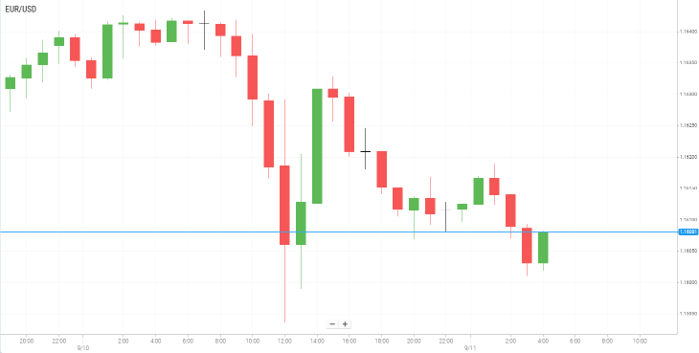
Gold remains under pressure near a one-and-a-half-week low in early Asian trading on Friday, with the precious metal struggling to stage a meaningful recovery. A stronger US Dollar, supported by rising expectations for a Federal Reserve rate hike next week, continues to weigh on the non-yielding asset.
The latest US Producer Price Index data reinforced the case for tighter monetary policy.
Meanwhile, elevated energy prices are adding to inflation concerns. Oil prices climbed to their highest level since May as tensions between the US and Iran intensified, while further geopolitical developments have kept demand for the safe-haven US Dollar supported.
Investors are now turning their attention to the US Consumer Price Index report for further clues on the Fed’s next move. A stronger-than-expected CPI reading could reinforce rate-hike expectations, push the USD higher and place additional pressure on gold.
With XAU/USD approaching the $4,300 level, the metal remains vulnerable to further losses if US inflation comes in hotter than expected. However, softer CPI data could ease pressure on the dollar and allow gold to recover.
Oil prices extended their gains early on Friday, with Brent and WTI on track for their strongest weekly advance since July as escalating attacks across key Middle East shipping routes raised concerns over prolonged supply disruptions.
Supply concerns intensified after Iran-aligned Houthis seized Yemen’s port of Mocha, increasing the threat to shipping through the Red Sea and the Bab al-Mandeb Strait. At the same time, tanker attacks and continued restrictions around the Strait of Hormuz have disrupted traffic through one of the world’s most important oil transit routes.
The conflict has also expanded beyond the immediate Iran-Hormuz area, with attacks on Saudi energy infrastructure adding to fears that supply disruptions could persist across the wider region. US President Donald Trump further heightened tensions by warning that Washington could target Iran’s Pickaxe Mountain near the damaged Natanz nuclear facility and suggesting the conflict could continue beyond the November midterm elections.
The impact is already being felt in energy markets, with the US national average diesel price exceeding $6 a gallon for the first time, while Ukrainian attacks on Russian refineries have added further pressure to global refined-product supplies.
Looking ahead, China’s crude demand will be crucial for the sustainability of the rally. Continued buying from the world’s largest oil importer could amplify the impact of supply disruptions and provide additional upside for prices. Meanwhile, OPEC has cut its 2026 global oil demand growth forecast for a fifth consecutive time to 380,000 barrels per day, while August output fell by around 640,000 bpd.
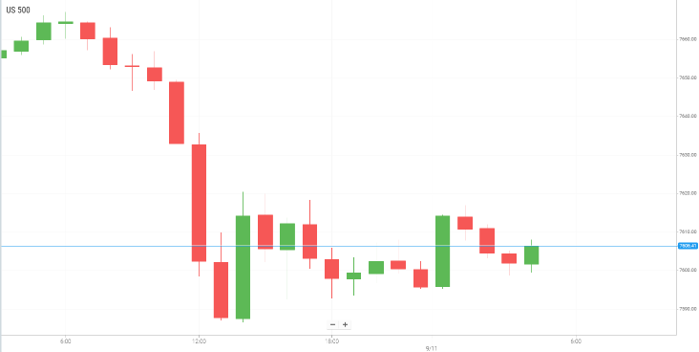
US stocks ended lower on Thursday, while Treasury yields jumped after hotter-than-expected producer inflation strengthened expectations for a Federal Reserve rate hike next week. Rising oil prices added further pressure to investor sentiment as markets awaited Friday’s CPI report.
The economic data pushed markets to further increase bets on a Fed rate hike at the September 16 meeting. Attention now turns to the US CPI report, which could have a major influence on expectations for monetary policy.
Among individual stocks, Apple jumped 3.6% after unveiling its first foldable iPhone. Investors will also be watching upcoming results from Oracle and Adobe for further clues on corporate spending and demand for artificial intelligence infrastructure.
With inflation data, Treasury yields and oil prices all moving higher, markets remain vulnerable to further volatility. Friday’s CPI report is now the key catalyst, with a hotter reading likely to reinforce Fed hike expectations and keep pressure on equities and bonds.
The materials contained on this document should not in any way be construed, either explicitly or implicitly, directly or indirectly, as investment advice, recommendation or suggestion of an investment strategy with respect to a financial instrument, in any manner whatsoever. Any indication of past performance or simulated past performance included in this document is not a reliable indicator of future results. For the full disclaimer click here.
Join iFOREX to get an education package and start taking advantage of market opportunities.
 A beginner's e-book
 $5,000 practice demo account
 A 12-part video course
 Trusted partner
 Featured partner
 By
By 


