
Listed on 
 Years active
 English (Arabic)
 Chinese Simplified - 中文 (简体)
 Chinese Traditional - 中文 (繁體)
 English
 Japanese - 日本語
 Korean - 한국어 (대한민국)
 Portuguese - Português
 Russian - Русский
 Spanish - Español
 Thai - ไทย
 English (India)
Don't have an account?
Register via AppHave an account?
Login 02/10/2026 - 06:53 UTC
The US Dollar Index (USDX) gathered solid upward momentum and edged higher by 0.59%, extending gains to trade near 18-month highs above the key 102.00 level. Encouraging US manufacturing numbers and persistent inflation fears tied to elevated energy prices provided substantial support for the greenback, keeping long-term US Treasury yields elevated despite a minor temporary retreat. Consequently, market expectations for an additional Federal Reserve rate hike in October eased significantly, though a December policy tightening remains largely priced in by market participants.
Gold prices posted modest gains and rose by 0.62%, recovering back toward the $4,200 per ounce mark. Persistent US dollar strength and elevated bond yields continued to act as primary headwinds for non-yielding bullion, though steady safe-haven interest stemming from escalating Middle East tensions provided a crucial cushion against steeper downside momentum.
WTI Crude Oil rebounded sharply and surged 3.31%, regaining lost ground as geopolitical supply disruption risks flared up once again. Escalating US-Iran tensions—highlighted by reports of potential military deployments and fresh attacks on oil tankers near the Strait of Hormuz—maintained a steep geopolitical risk premium on crude prices, effectively offsetting mixed technical setup signals.
Asian equity markets delivered mixed performances ahead of the upcoming key data releases. Japanese benchmark indexes came under pressure, led by tech weakness as SoftBank tumbled 6.31% and Kioxia eased 0.39%. Semiconductor manufacturers across the region saw varied activity: SK Hynix gained 0.29%, while Samsung Electronics slipped 0.17%. In Hong Kong, major tech heavyweights retreated amid broader risk aversion, with Tencent dropping 2.55%, Alibaba falling 0.13%, and Baidu losing 1.47%.
US equities concluded the prior session slightly higher, underpinned by underlying strength in key technology benchmarks following robust quarterly earnings from Micron, which advanced 2.89%. Mega-cap tech names displayed resilience as Nvidia gained 1.01%, while Nike drifted 0.85% lower as investors carefully weighed corporate guidance against broader macroeconomic uncertainties.
Looking ahead to later today, investor attention turns directly to the key US Nonfarm Payrolls (NFP) report, expected to show the economy added 90K jobs in September while the Unemployment Rate holds steady at 4.1%, providing fresh impetus to global asset classes. Looking further ahead to next week, market participants will focus on corporate earnings reports from PepsiCo and Delta Air Lines, upcoming comments from BOJ Governor Ueda, the release of the FOMC Meeting Minutes, and a scheduled policy speech by BOE Governor Bailey.
EUR/USD was trading around 1.1250 level during Friday’s Asian trading session as concerns over France’s fiscal outlook weighed on the Euro. Market attention is now turning to the release of the US September employment report later on Friday, which could provide fresh clues about the Federal Reserve’s interest rate path.
French 10-year government bond yields eased after reaching their highest level since 2002 in the previous session. The move followed the French government’s unveiling of its 2027 budget, which intensified concerns over the country’s fiscal trajectory. At the same time, renewed strength in oil prices amid the prolonged US-Iran conflict has contributed to higher inflation expectations, putting additional upward pressure on bond yields.
Hawkish comments from Federal Reserve officials, combined with elevated US Treasury yields, have provided further support to the Greenback. Dallas Fed President Lorie Logan said on Thursday that the central bank may need to raise short-term borrowing costs by at least 50 basis points to make monetary policy “modestly restrictive” and bring inflation back toward the Fed’s 2% target.
According to the CME FedWatch Tool, markets are currently pricing in a 24.9% probability of a Fed rate hike in October, while the probability of an increase in December stands at 79.4%.
Investors will closely watch the US September employment report on Friday for further indications about the outlook for US interest rates. Nonfarm Payrolls are expected to show an increase of 90,000 jobs in September, while the Unemployment Rate is forecast to remain unchanged at 4.1%.
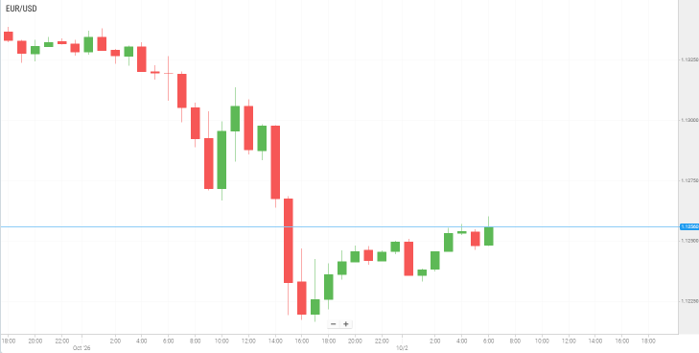
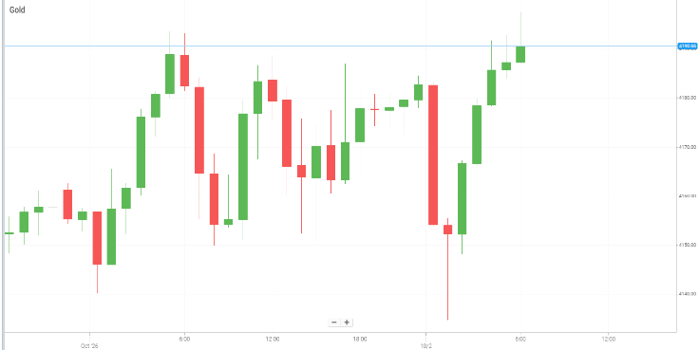
Gold prices recovered some lost ground, rising to around $4,180 during Friday’s early Asian trading session as US Treasury yields eased from multi-decade highs. However, the upside in the precious metal could remain limited amid persistent inflation concerns stemming from elevated energy prices and expectations of higher US interest rates.
The US 10-year Treasury yield, a key benchmark for global borrowing costs and asset prices, retreated to 5.24% after briefly surging to 5.34% earlier in the session, marking a new multi-decade high. The 30-year Treasury yield also approached levels not seen in 24 years before easing toward the end of the session.
Market attention is now focused on the US September employment report, which could provide further clues about the Federal Reserve’s interest rate outlook.
Anything that would increase the likelihood of a Fed rate hike would certainly dent sentiment in the gold market. Any additional strong rise in energy prices or any escalation in the Middle East would also do the same.
A stronger-than-expected US jobs report could reinforce expectations for tighter monetary policy, potentially weighing on gold, while weaker employment data could reduce rate-hike expectations and provide additional support for the precious metal.
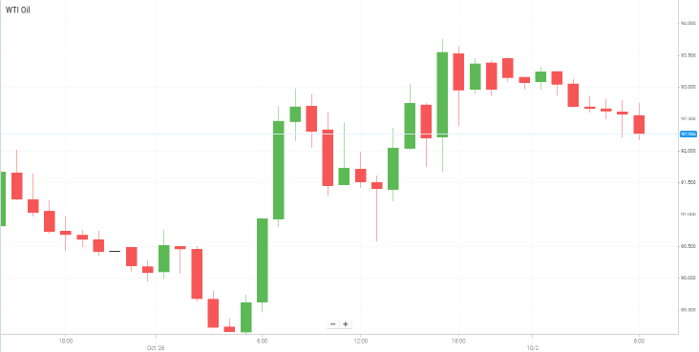
Oil prices were largely steady on Friday after surging in the previous session, as investors assessed the risk of a broader Middle East conflict following reports that the United States was considering sending additional military assets to the region amid its war with Iran.
The gains came after a Wall Street Journal report indicated that Washington was considering deploying another aircraft carrier group and additional troops to the Middle East. The prospect of renewed military action involving Tehran has raised concerns that an escalation could disrupt oil supplies and threaten energy flows from the region.
The potential for further conflict has kept traders focused on the Strait of Hormuz, a critical shipping route through which a significant portion of global energy supplies passes. Although Gulf oil exports have shown signs of recovery, markets remain highly sensitive to any disruption to tanker traffic, export facilities or regional energy infrastructure.
Saudi Arabia has restarted operations on its East-West Pipeline and resumed tanker loadings from Yanbu following earlier disruptions, helping regional exports recover. However, concerns about refined-product supplies remain. Reports indicated that Chinese refiners have suspended fuel exports beyond Hong Kong and Macau in October, a move that could tighten global markets for refined products such as diesel, jet fuel and gasoline.
The decision comes as global diesel markets remain under pressure from lower Russian exports and concerns over potential restrictions on US fuel shipments.
Despite the recent rally in crude prices, recovering Middle East supply flows and concerns about global oil demand have limited further gains. Market participants are likely to remain focused on developments in the Middle East, particularly any signs of disruption to oil production, exports or shipping through the Strait of Hormuz, as these factors could have a significant impact on the near-term outlook for crude prices.
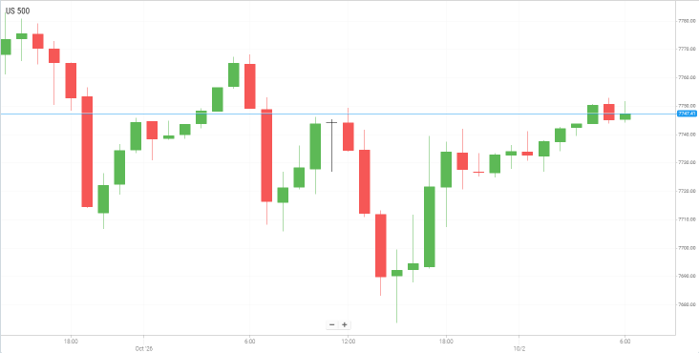
Wall Street started October on a slightly firmer note, with the US 500 edging higher late on Thursday as a decline in US Treasury yields helped offset a sharp rise in oil prices. The move came as investors digested a series of economic indicators while continuing to assess the outlook for Federal Reserve interest rates.
Recent economic data has complicated the interest-rate outlook. The Federal Reserve’s preferred inflation gauge showed smaller-than-expected monthly and annual increases in August, while the annual readings also moderated from July. At the same time, the estimate for US second-quarter real GDP growth was revised sharply higher to 2.2% from 1.5%, while a monthly measure of private employment showed that hiring accelerated in September for the first time since May.
The latest data pointed to a combination of stronger economic growth, a resilient labor market and moderating inflation. However, the Institute for Supply Management’s September manufacturing report showed that price pressures were building again. Attention now turns to Friday’s US Nonfarm Payrolls report, which could provide further clues about the Federal Reserve’s next policy moves.
Among individual stocks, Micron Technology gained 3% after initially falling following the release of stronger-than-expected fiscal fourth-quarter results and better-than-anticipated guidance. The company warned of slightly softer gross margins and higher operating expenses for fiscal 2027, but its results nevertheless supported expectations that strong artificial intelligence demand will continue to underpin the semiconductor and technology sectors.
Nike was also in focus ahead of its quarterly earnings release, with investors watching for signs of progress under CEO Elliott Hill as the company works to revive its business. Nike shares had fallen more than 44% during the year through Thursday.
The materials contained on this document should not in any way be construed, either explicitly or implicitly, directly or indirectly, as investment advice, recommendation or suggestion of an investment strategy with respect to a financial instrument, in any manner whatsoever. Any indication of past performance or simulated past performance included in this document is not a reliable indicator of future results. For the full disclaimer click here.
Join iFOREX to get an education package and start taking advantage of market opportunities.
 A beginner's e-book
 $5,000 practice demo account
 A 12-part video course
 Trusted partner
 Featured partner
 By
By 


