
Listed on 
 Years active
 English (Arabic)
 Chinese Simplified - 中文 (简体)
 Chinese Traditional - 中文 (繁體)
 English
 Japanese - 日本語
 Korean - 한국어 (대한민국)
 Portuguese - Português
 Russian - Русский
 Spanish - Español
 Thai - ไทย

 English (India)

Don't have an account?
Register via AppHave an account?
Login 13/11/2026 - 08:28 UTC
The United States Dollar Index (USDX) entered a consolidation phase above the 103.00 mark during Friday's Asian session following a strong +0.67% rally that lifted the index to its highest level since April 2025. The Greenback remains well-supported by hotter-than-expected U.S. inflation metrics and hawkish Federal Reserve commentary, pushing benchmark 10-year U.S. Treasury yields comfortably past 5%. CME FedWatch pricing indicates that a 25-basis-point rate hike in December is fully priced in, alongside an approximate 13%–14.5% probability of a 50-basis-point increase.
Global commodity and energy markets experienced sharp divergence as surging U.S. yields clashed with renewed geopolitical friction and supply data. Gold (XAU/USD) slumped -2.47% in the previous session before staging a modest recovery above $3,900 per ounce on Friday, snapping a three-day losing streak though remaining capped by dollar strength. Meanwhile, WTI Oil climbed +2.89% overnight before retreating toward $87.50 per barrel in early Asian trading. Crude prices faced downward pressure after Energy Information Administration (EIA) data revealed a 9-million-barrel build in U.S. stockpiles, though fresh warnings from President Donald Trump against Iran and attacks on Saudi energy infrastructure and Strait of Hormuz shipping kept supply risks elevated.
Geopolitical and corporate developments dominated headlines as sudden executive turnover rocked the semiconductor industry. Nvidia co-founder and CEO Jensen Huang abruptly resigned on Thursday following an internal board probe into personal misconduct allegations, with CFO Colette Kress appointed as interim CEO. The Senate Banking Committee has subsequently requested testimony from Huang and Commerce Secretary Howard Lutnick regarding the developments. On the geopolitical front, President Trump stated the U.S. does not need a deal with Iran and threatened decisive military action in response to any attacks on American personnel.
Asian equity markets delivered a mixed performance on Friday as investors weighed chip-access concerns and Nvidia's leadership transition. Japan's Nikkei 225 advanced alongside selective semiconductor suppliers, while Hong Kong's Hang Seng declined amid fears of tighter U.S. export curbs and potential import bans on Chinese optical transceivers. Notable regional technology movers in the latest session included Sony (+1.95%), Kioxia (-0.27%), TDK (-0.71%), and Tencent (-2.56%).
U.S. equity markets ended lower on Thursday, with the main U.S. equity indices moving moderately lower as governance shockwaves at Nvidia pressured the broader chip sector. Nvidia (-4.30%) closed firmly in the red after plunging as much as 14% intraday, whereas rival chipmakers AMD (+5.92%) and Broadcom (+5.50%) rallied on expectations of potential market share gains. Microsoft (+0.44%) edged higher, supported by a new partnership announcement with AI chipmaker Cerebras Systems, which surged after hours on upbeat quarterly results.
Cryptocurrency markets suffered sharp losses as tightening monetary policy expectations dented risk appetite. Bitcoin declined -3.46% in the prior session before sliding an additional 4% early Friday to fall below the $70,000 threshold, touching a near three-month low amid hawkish Federal Reserve rate bets and concerns over Strategy's potential removal from MSCI indexes.
Looking ahead, market participants turn their attention to today's U.S. Producer Price Index (PPI) release and scheduled FOMC member speeches for further policy cues to close out the week. Next week's macroeconomic calendar kicks off on Monday, November 16, with a speech from Fed Chairman Kevin Warsh at 7:00pm, followed on Tuesday, November 17, by RBA Governor Michele Bullock's remarks at 12:50am and U.S. Retail Sales data at 3:30pm (Core Retail Sales m/m expected at 0.9%, headline Retail Sales m/m expected at 0.8%). On Wednesday, November 18, focus shifts to UK CPI y/y at 9:00am (expected at 3.5%), dual speeches from BOE Governor Andrew Bailey at 9:30am and 5:00pm, and the FOMC Meeting Minutes at 9:00pm, alongside Nvidia's third-quarter earnings report on Tuesday.
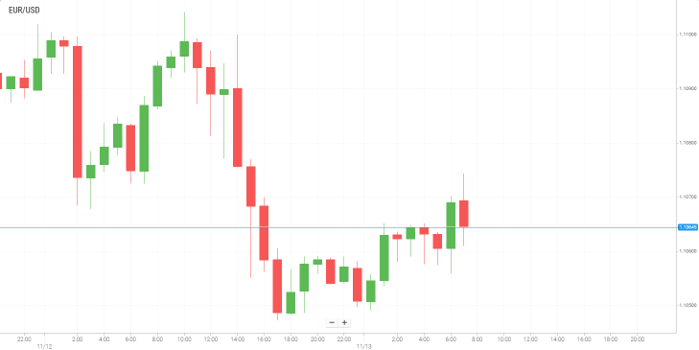
The EUR/USD was trading around 1.1050 during Friday’s Asian session as the US dollar strengthens amid persistent inflation concerns and growing expectations of further Federal Reserve interest rate increases.
Stronger-than-expected US Consumer Price Index (CPI) data released earlier this week reinforced market expectations of a potential Fed rate hike in December. Federal Reserve Governor Christopher Waller indicated that a 50-basis-point increase should be considered if core inflation remains elevated. Following the inflation report, markets began pricing in a 14.5% probability of a 50-basis-point rate hike, compared with zero before the data was released.
Investors are now turning their attention to Friday’s US October Producer Price Index (PPI) report for further indications of inflationary pressures and the Fed’s future monetary policy direction. Headline PPI is expected to increase by 6.6% year-on-year, while core PPI is forecast to rise by 5.0%.
Meanwhile, rising geopolitical tensions involving Iran have added to inflation concerns. US President Donald Trump stated on Thursday that the United States did not need an agreement with Iran, dampening hopes of a diplomatic resolution to the conflict. The comments triggered a rise in oil prices, further intensifying concerns about persistent inflation.
On the European side, uncertainty surrounding the region’s economic outlook continues to weigh on expectations for the European Central Bank’s (ECB) monetary policy. Although the ECB has raised interest rates twice this year and is widely expected to deliver one final increase at its December meeting, growing economic uncertainty could bring the current tightening cycle to an end. This divergence in monetary policy expectations between the Fed and the ECB continues to put additional pressure on the euro.
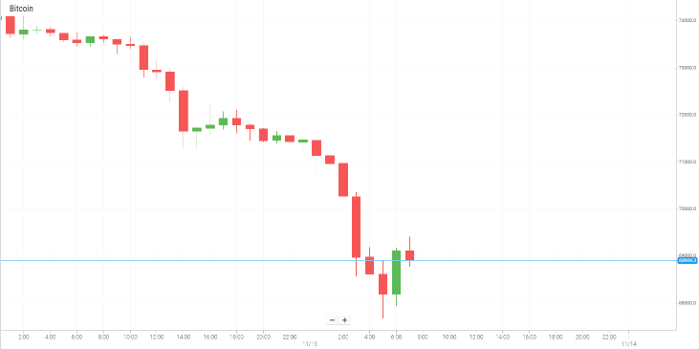
Bitcoin fell below the $70,000 level on Friday, reaching a near three-month low as growing expectations of further Federal Reserve interest rate hikes and concerns surrounding Strategy’s potential removal from MSCI benchmark indexes weighed on cryptocurrency market sentiment.
The latest decline reflects increasing pressure on the cryptocurrency market, which has struggled since October amid a combination of monetary policy uncertainty, regulatory concerns and weakening investor appetite for riskier assets. Stronger-than-expected US inflation data for October has reinforced expectations that the Federal Reserve could raise interest rates as soon as December. Markets are now pricing in between 25 and 50 basis points of potential tightening, according to CME FedWatch data.
Higher interest rates typically weigh on speculative assets such as cryptocurrencies by tightening financial conditions, reducing available liquidity and encouraging investors to shift capital towards safer investments, including government bonds. Bitcoin has historically struggled in periods of elevated interest rates, making the prospect of further monetary tightening an additional headwind for the market.
Meanwhile, Strategy has emerged as another source of concern for Bitcoin investors. MSCI announced that Strategy, the world's largest publicly listed Bitcoin treasury company, along with similar companies, will be excluded from its benchmark indexes effective November 30.
Overall, the combination of rising interest rate expectations, regulatory uncertainty and concerns over institutional Bitcoin exposure continues to undermine cryptocurrency market sentiment.
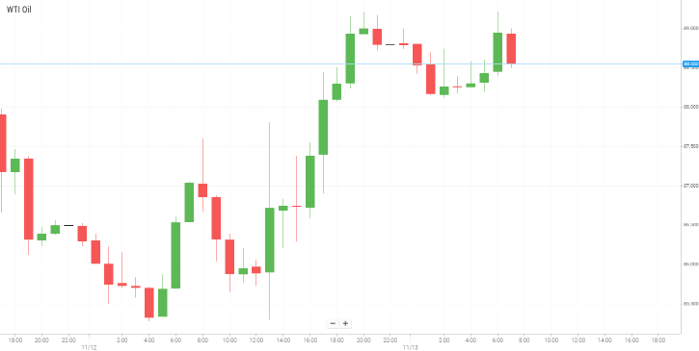
Oil prices declined on Friday, reversing gains from the previous two sessions, and remained on track for a second consecutive weekly loss as US President Donald Trump’s latest comments on Iran reduced hopes of a diplomatic breakthrough to end the conflict and restore energy flows from the Middle East.
Oil prices came under pressure after Trump stated on Thursday that Washington no longer needed an agreement with Tehran, arguing that the United States had established significant financial leverage over Iran and secured control of the Strait of Hormuz. He also instructed Vice President JD Vance to shift his attention towards domestic priorities rather than continuing negotiations with Iran, dealing another setback to diplomatic efforts. Washington has indicated that its naval blockade of Iranian trade and oil shipments will remain in place alongside broader economic sanctions.
The comments followed a volatile week in which earlier hopes of diplomatic progress were undermined by renewed attacks on Saudi infrastructure by Yemen’s Iran-backed Houthis, as well as strikes on tankers transporting crude from the Gulf. Security risks across the Persian Gulf remain elevated, with Verisk Maplecroft reporting 36 confirmed attacks on commercial vessels across the Persian Gulf, the Strait of Hormuz and the Gulf of Oman during October, marking the highest monthly figure since the conflict began.
On the supply side, OPEC crude production increased by 1.96 million barrels per day to 27.16 million barrels per day in October, approaching its pre-war level of 28.63 million barrels per day recorded in February. Saudi Arabia accounted for a significant portion of the recovery, increasing production to 10.56 million barrels per day from 8.37 million in September.
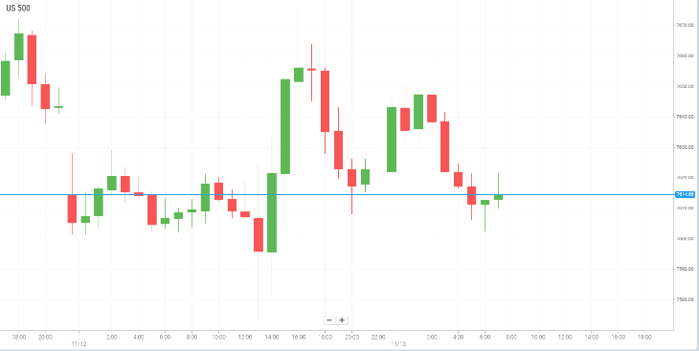
US stock index futures moved lower early Friday as the recovery in technology shares lost momentum amid growing concerns over a potential leadership crisis at Nvidia following the abrupt departure of CEO Jensen Huang. Investors also remained cautious ahead of the release of October’s US Producer Price Index (PPI) data, particularly after stronger-than-expected consumer inflation figures earlier this week reinforced expectations of further Federal Reserve interest rate increases.
Despite the latest weakness, Wall Street remained on track for weekly gains, with technology stocks retaining some of their recent recovery following losses throughout October and early November. Nvidia shares remained under pressure in after-hours trading, falling approximately 2% following a decline of more than 4% during Thursday’s regular session. The company faced renewed uncertainty after reports surrounding Jensen Huang’s departure, which followed allegations of personal misconduct, including reported relationships with Nvidia employees and a suspected Chinese spy. Huang had led the company since co-founding it in 1993, overseeing its transformation into a leading artificial intelligence chipmaker.
However, some of Nvidia’s competitors benefited from expectations that the leadership disruption could create opportunities to capture additional market share. Advanced Micro Devices (AMD) and Broadcom (AVGO) both gained more than 5%, while AI chipmaker Cerebras Systems surged 17% in after-hours trading after reporting stronger-than-expected quarterly revenue and guidance, alongside announcing a new agreement with Microsoft.
Investors will now focus on Friday’s October PPI report for further indications of inflationary pressures and potential changes in monetary policy expectations. Several Federal Reserve officials are also scheduled to speak, potentially providing additional insight into the central bank’s outlook.
The materials contained on this document should not in any way be construed, either explicitly or implicitly, directly or indirectly, as investment advice, recommendation or suggestion of an investment strategy with respect to a financial instrument, in any manner whatsoever. Any indication of past performance or simulated past performance included in this document is not a reliable indicator of future results. For the full disclaimer click here.
Join iFOREX to get an education package and start taking advantage of market opportunities.
 A beginner's e-book
 $5,000 practice demo account
 A 12-part video course
 Trusted partner

 Featured partner
 By


