
Listed on 
 Years active
 English (Arabic)
 Chinese Simplified - 中文 (简体)
 Chinese Traditional - 中文 (繁體)
 English
 Japanese - 日本語
 Korean - 한국어 (대한민국)
 Portuguese - Português
 Russian - Русский
 Spanish - Español
 Thai - ไทย

 English (India)

Don't have an account?
Register via AppHave an account?
Login 30/10/2026 - 07:59 UTC
The United States Dollar Index (USDX) traded with a soft bias during early European hours on Friday, sliding 0.23% to hover near 101.70. The Greenback faced downward pressure as safe-haven demand waned following reports of direct U.S. diplomatic outreach to Iran, which helped ease immediate Middle Eastern supply and inflation fears. CME FedWatch pricing reflected a lower probability of a December Fed rate increase (down to nearly 75% from 84.2% a day prior). However, broad USD losses were restricted by robust U.S. macroeconomic releases, including a strong preliminary Q3 GDP print of 3.4% (vs. 3.2% expected), a tight labor market with initial jobless claims dipping to 194K, and Core PCE inflation matching expectations at 3.1% y/y.
Global commodity and FX markets experienced mixed trading conditions as investors evaluated central bank developments and geopolitical updates. The Bank of Japan (BOJ) held its policy rate steady at 1.25%, but delivered a hawkish signal by noting that underlying inflation has effectively reached its 2% target, bolstering expectations for a December rate hike following Tokyo Core CPI printing at 2.6% y/y. Gold (XAU/USD) remained under significant selling pressure, declining 1.14% to trade below the $4,000 per ounce threshold as persistent Fed tightening expectations and rebounding economic growth figures offset lower Treasury yields and a weaker Dollar.
West Texas Intermediate (WTI Oil) steadied and recorded a net gain of 0.99%, trading near $102.00 per barrel after pulling back from an intraday five-month high of $104.00. Crude prices found support despite reported U.S.-Iran diplomatic contacts led by Vice President JD Vance. Ongoing threats of post-midterm U.S. military strikes, reports of Houthi missile and drone attacks against Saudi energy facilities, and Iranian naval claims of oil tankers striking sea mines in the Strait of Hormuz continued to maintain a solid geopolitical risk premium.
Asian stock markets experienced sharp losses on Friday, led by a deep selloff in artificial intelligence and semiconductor shares. South Korea's KOSPI slumped as key memory producers extended declines, with SK Hynix dropping 7.04% and Samsung Electronics falling 3.02% following missed chip division profit expectations. In Japan, the Nikkei 225 dropped sharply on heavy losses across technology leaders, including Lasertec (-9.42%), Kioxia Holdings (-9.78%), Advantest (-6.88%), and SoftBank Group (-5.50%). Chinese benchmarks traded lower, whereas Hong Kong's Hang Seng outperformed regional peers to post modest gains.
U.S. equity markets closed lower in the previous session, weighed down by severe weakness across communication services and mega-cap technology shares. Investor sentiment was hit hard by Alphabet, which plunged 12.39% following its Q3 bottom-line miss driven by lower Google Services revenue and heavy AI spending. Broad technology weakness extended into chipmakers and mega-cap peers, with Intel falling 3.63% (and plunging further in after-hours trading following weak Q4 guidance) and Amazon declining 4.16%.
Looking ahead, market participants are monitoring a heavy lineup of earnings today alongside major economic events scheduled for next week. Today, traders will track quarterly reports from energy and healthcare giants including ExxonMobil, AbbVie, and Chevron. Next week, central bank decisions and political developments will dominate headlines. On Tuesday, attention turns to the Reserve Bank of Australia alongside the U.S. Congressional Elections. On Thursday, focus shifts to the Bank of England. The week concludes on Friday with the critical U.S. labor market report (Non-Farm Employment Change expected at 29K, Unemployment Rate expected at 4.2%) alongside a speech by BOJ Governor Kazuo Ueda.
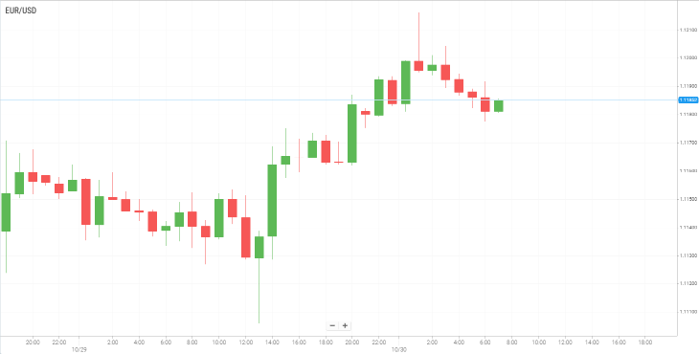
The EUR/USD posted modest gains early on Friday. The recovery is supported by a combination of a hawkish European Central Bank (ECB) outlook and renewed weakness in the US Dollar. The Euro continues to benefit from expectations that the ECB could raise interest rates in December, as rising energy costs increase inflationary pressures across the euro area. Meanwhile, the US Dollar remains under pressure, retreating from its recent two-week high amid declining US Treasury yields and growing hopes for renewed diplomatic efforts to ease tensions in the Middle East.
Recent developments have raised hopes for a possible diplomatic breakthrough, with US Vice President JD Vance reportedly sending a direct letter to Iran's Supreme National Security Council in an effort to restart peace negotiations. Additionally, Qatari mediators have presented Iran with a new draft proposal aimed at ending the conflict involving the US and Israel. However, escalating regional tensions, including hostilities involving the Houthis in Yemen and Saudi Arabia, continue to keep investors cautious.
According to the CME Group's FedWatch Tool, markets are currently pricing in approximately a 75% probability of another Fed rate hike in December. These expectations have been reinforced by recent US economic data showing that GDP expanded at an annualized rate of 3.4% during the July-September quarter, while inflation remained above the Fed's 2% target in September. The combination of resilient US economic growth, persistent inflationary pressures and geopolitical uncertainty could encourage renewed demand for the US Dollar, potentially limiting further losses.
Market participants will now turn their attention to the euro area's preliminary third-quarter GDP figures and consumer inflation data for fresh trading signals. These releases could provide further insight into the ECB's monetary policy outlook and determine the pair's next directional move.
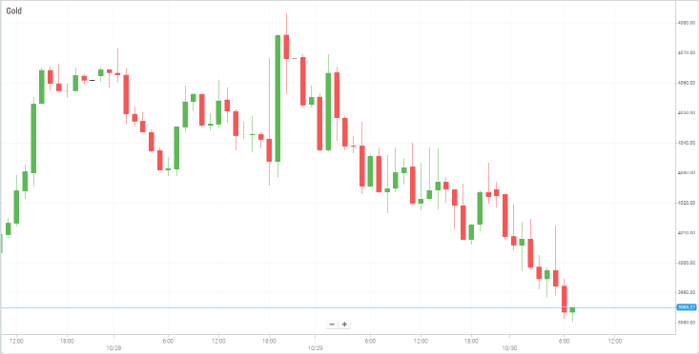
Gold prices remained under significant selling pressure for a second consecutive session on Friday, slipping below the key $4,000 psychological level and approaching their monthly low. The precious metal continues to face downward pressure as growing expectations of another US Federal Reserve (Fed) interest rate hike in December weigh on demand for the non-yielding asset.
Recent US economic data have reinforced expectations of tighter monetary policy, with economic growth proving more resilient than anticipated and inflationary pressures remaining elevated. Despite the pressure on bullion, declining US Treasury yields have limited the broader strength of the US Dollar. Investors have moved towards safe-haven government bonds following disappointing technology sector earnings, raising concerns about whether substantial artificial intelligence investments will generate sufficient returns. At the same time, renewed hopes for a diplomatic resolution to the Middle East conflict have weighed on the US Dollar for a third consecutive session. However, these developments have failed to provide meaningful support for Gold, as monetary policy expectations remain the dominant market driver.
Overall, the combination of persistent inflation, resilient US economic growth and growing expectations of a December rate hike leaves Gold vulnerable to further declines below the $4,000 level. Any short-term recovery could attract fresh selling interest, particularly if markets continue to price in a more hawkish Fed policy outlook. The precious metal remains on track to record a monthly loss of approximately 3.5%.
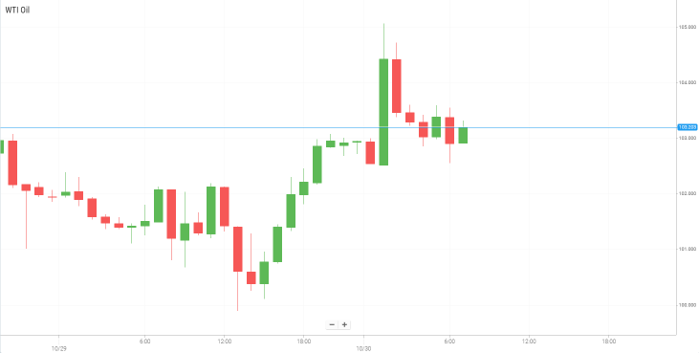
Oil prices climbed towards six-month highs on Friday as escalating geopolitical tensions in the Middle East raised concerns about potential supply disruptions and weakened hopes for a diplomatic resolution between the US and Iran.
The latest gains were driven by renewed concerns over the possibility of further US military action against Iran. According to reports by The Wall Street Journal, US Central Command chief Admiral Brad Cooper briefed President Donald Trump on military options concerning Iran during a White House meeting on Thursday, attended by Defence Secretary Pete Hegseth and other senior officials. Discussions reportedly included the ongoing US blockade and the possibility of renewed large-scale military operations. Trump has also indicated that further military strikes remain a possibility following the November 3 US midterm elections, adding to uncertainty surrounding the region.
These developments have overshadowed ongoing diplomatic efforts to resolve the conflict. US Vice President JD Vance has reportedly contacted Iranian security official Mohsen Rezaei in an attempt to revive negotiations, while regional mediators continue working on a potential framework for ending hostilities. However, Tehran has reportedly rejected a proposed settlement, reducing expectations of an imminent diplomatic breakthrough and keeping geopolitical risks elevated.
Fundamental supply data have also provided additional support to the market. According to the US Energy Information Administration (EIA), commercial crude oil inventories declined by 1.9 million barrels during the week ended October 23, reaching 410.6 million barrels. The drawdown contradicted market expectations for a modest inventory increase, suggesting tighter supply conditions in the US market.
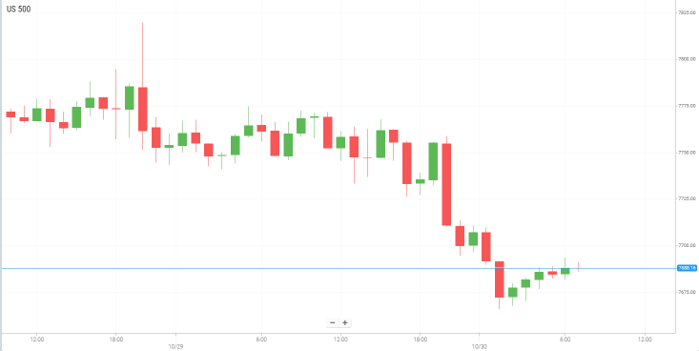
US stock index futures declined sharply early Friday, with the US Tech 100 leading losses as disappointing earnings from major technology companies Amazon and Intel intensified concerns over elevated artificial intelligence (AI) spending and weakening profitability across the sector. The weakness followed a negative session on Wall Street, where technology stocks remained under considerable pressure after disappointing results from Alphabet
Technology stocks extended their losses during Friday's Asian session, reflecting the negative sentiment carried over from Wall Street. Additional pressure came from hawkish signals by the Bank of Japan, which strengthened expectations of further interest rate increases as the central bank indicated greater confidence in achieving its inflation objectives.
Amazon shares declined 6.7% in after-hours trading following a 4.16% loss during Thursday's regular session. The company reported September-quarter results that missed both revenue and earnings expectations, while substantial investments in artificial intelligence further weakened its free cash flow position.
Intel also came under heavy selling pressure, plunging nearly 23% in after-hours trading despite reporting a stronger third-quarter profit. Investors focused instead on disappointing fourth-quarter guidance and revenue figures that fell short of expectations. Although Intel's server CPU business continues to benefit from AI-related demand, its personal computer division faces mounting pressure from higher costs and weakening consumer demand. Disappointing results from Samsung Electronics further contributed to concerns about excessive investment and uncertain returns across the semiconductor industry.
Overall, the combination of disappointing technology earnings, concerns over excessive AI investment and rising expectations of another Fed rate hike has weakened risk appetite across global equity markets.
The materials contained on this document should not in any way be construed, either explicitly or implicitly, directly or indirectly, as investment advice, recommendation or suggestion of an investment strategy with respect to a financial instrument, in any manner whatsoever. Any indication of past performance or simulated past performance included in this document is not a reliable indicator of future results. For the full disclaimer click here.
Join iFOREX to get an education package and start taking advantage of market opportunities.
 A beginner's e-book
 $5,000 practice demo account
 A 12-part video course
 Trusted partner

 Featured partner
 By


