
Listed on 
 Years active
 English (Arabic)
 Chinese Simplified - 中文 (简体)
 Chinese Traditional - 中文 (繁體)
 English
 Japanese - 日本語
 Korean - 한국어 (대한민국)
 Portuguese - Português
 Russian - Русский
 Spanish - Español
 Thai - ไทย
 English (India)
Don't have an account?
Register via AppHave an account?
Login 24/08/2026 - 06:29 UTC
The United States Dollar Index (USDX) faced downward pressure last week, declining by 0.8% as it softened below the 99.00 level. This weakness was primarily driven by US fiscal concerns stemming from the Treasury’s bond buyback plans and declining expectations for near-term Federal Reserve interest rate hikes, leaving the greenback vulnerable to further downside risk.
Amid the broader greenback pullback, Gold surged significantly, posting a strong weekly gain of 5.49%. The precious metal capitalized on lower US Treasury bond yields and fading bets on aggressive central bank tightening, pushing prices to fresh multi-month highs as safe-haven demand gathered momentum across global markets.
West Texas Intermediate (WTI) crude oil also recorded notable upward momentum last week, advancing by 5.17%. Prices climbed as traders weighed escalating geopolitical tensions in the Middle East and anticipated tighter sanctions affecting Iranian oil exports against persistent profit-taking behavior, ultimately providing a solid floor for energy market bulls.
Asian stock markets fell sharply on Monday as technology shares came under renewed pressure, with South Korea's KOSPI dropping as Samsung Electronics plunged 8% despite posting a weekly gain of 2.37%, while SK Hynix slid after a weekly advance of 5.29%. Regionally, Hong Kong's Hang Seng index sank dragged lower by Alibaba's near 8.5% collapse following a heavily discounted $10.2 billion share placement, alongside broader weakness across Asian tech supply chains and escalating U.S.-Canada trade tensions.
US equities futures pointed to continued downside momentum following a volatile week, with Nasdaq 100 Futures and S&P 500 Futures trading lower in early regional sessions. Individual megacap names faced distinct headwinds, with Nvidia slipping ahead of its key quarterly report after finishing the previous week down -4.65%, while Tesla grappled with a massive 4.3 million vehicle recall in China despite capping off a strong weekly surge of 5.93%.
Bitcoin traded slightly higher, recovering to trade near $77,300 following a temporary weekend pullback from its multi-day high of $79,501. The world's largest cryptocurrency demonstrated resilience amid a softer U.S. dollar, with the recent price stabilization offering immediate relief to network miners as hashing profitability jumped over 20% across four consecutive sessions.
The economic and earnings docket sets up a high-stakes week as market participants prepare for Nvidia's high-profile quarterly results on Wednesday alongside key earnings reports from corporate tech leaders including Intuit, CrowdStrike, Salesforce, and Synopsys. Macro traders are gearing up for U.S. Core PCE (forecast at 0.2% m/m) and preliminary GDP figures (expected at 1.5% q/q), capped off by Canadian monthly GDP on Friday. Investors are also bracing for Federal Reserve Chair Kevin Warsh's scheduled address at the Jackson Hole symposium.
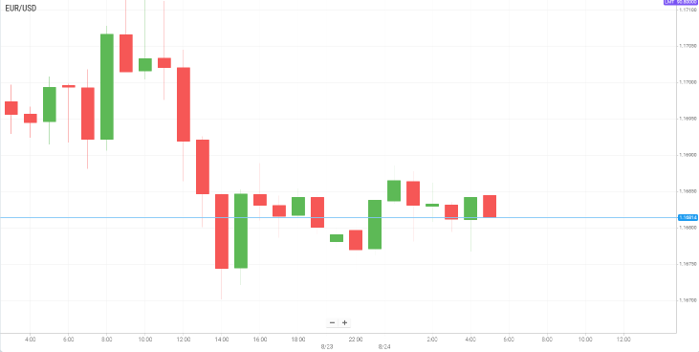
The EUR/USD pair was trading near 1.1680 during Monday’s Asian session as the pair remains supported as the US Dollar (USD) comes under pressure following new fiscal measures announced by the United States.
The US Treasury surprised markets by announcing plans to at least double its purchases of longer-dated government debt, in an effort to contain rising bond yields. Treasury Secretary Scott Bessent indicated that the buyback program could exceed $4 billion. The move is intended to signal that elevated Treasury yields may not fully reflect the underlying strength of the US economy.
Despite the Dollar’s recent weakness, further gains in EUR/USD could remain limited as geopolitical tensions in the Middle East boost demand for safe-haven assets. Tensions between the US and Iran have intensified, with Iranian Foreign Minister Abbas Araghchi describing forthcoming US sanctions as an act of desperation and arguing that they would not weaken Tehran. Iranian Security Chief Mohsen Rezaei has also warned of severe retaliation should US President Donald Trump take further action, adding to risk-off sentiment across financial markets.
The Euro continues to receive support from persistent inflation and expectations surrounding European Central Bank (ECB) monetary policy. Eurozone consumers’ one-year inflation expectations eased slightly to 2.9% in June from 3.0%, but inflation remains above the ECB’s 2% target.
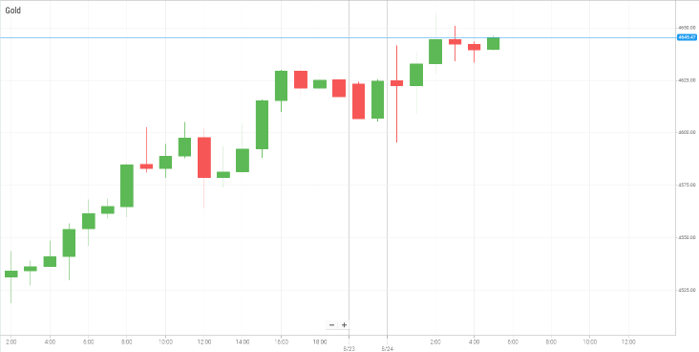
Gold extends its recent rally, climbing above $4,650 during Monday’s Asian session and reaching its highest level since mid-May.
Cooler July inflation data has reduced expectations for near-term monetary tightening, with markets increasingly anticipating that the Fed will keep interest rates unchanged at its September 15–16 FOMC meeting. Lower yields, in turn, reduce the opportunity cost of holding non-yielding Gold and provide additional support for the metal.
Gold is also benefiting from the US Treasury’s plans to increase its purchases of longer-dated government debt.
Against this backdrop, traders will closely monitor Wednesday’s US Personal Consumption Expenditures (PCE) Price Index for fresh clues about the inflation outlook. Investors will also scrutinize Fed Chair Kevin Warsh’s remarks at the Jackson Hole Symposium for signals about the future direction of monetary policy. Any hawkish shift could strengthen the US Dollar and potentially limit Gold’s upside.
Geopolitical tensions remain another important factor for both Gold and the US Dollar. US Treasury Secretary Scott Bessent is expected to announce what he has described as the toughest sanctions ever imposed on Iran.
Overall, Gold retains a bullish bias as softer US yields, reduced expectations for immediate Fed tightening and continued Dollar weakness support the precious metal. However, upcoming US inflation data, Fed commentary and rising geopolitical tensions could increase volatility and warrant caution among buyers.
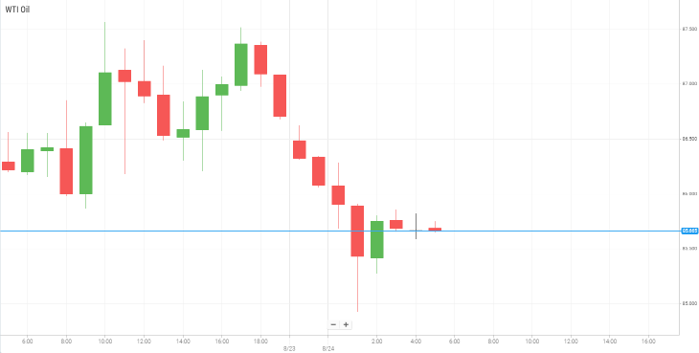
Oil prices fell early on Monday as investors took profits ahead of an expected US announcement on new sanctions against Iran, with markets assessing the potential impact on crude supplies from the Middle East.
US Treasury Secretary Scott Bessent is expected to announce new measures against Iran during a press conference on Monday. Bessent has described the planned action as potentially involving the “toughest sanctions in history,” while President Donald Trump has also threatened sanctions against countries that continue trading with Tehran.
Signs of tighter crude availability are already emerging. Offers of Iranian oil to Chinese buyers have declined, while prices have risen as US restrictions have reduced Tehran’s shipments.
At the same time, Iran has allowed several Iraqi oil tankers to pass through the Strait of Hormuz following repeated requests from Baghdad, according to Iranian state media. The development offers some relief for regional flows, but broader supply risks remain elevated as the US-Iran standoff continues.
Overall, oil prices remain vulnerable to profit-taking in the near term, but the downside could be limited by growing concerns over Middle East supply disruptions. The US sanctions announcement and Iran’s subsequent response are likely to be key drivers for crude prices in the days ahead.
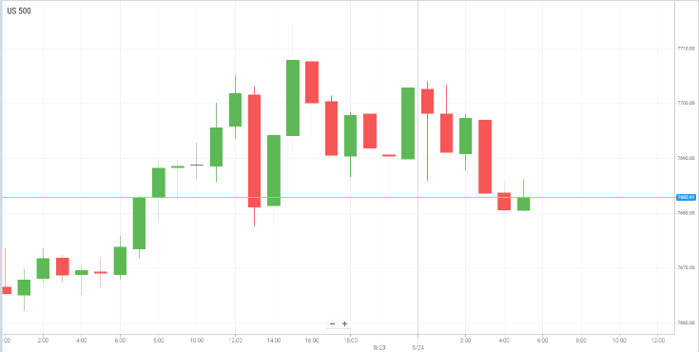
Wall Street ended Friday’s session higher, supported by gains in materials stocks, a strong performance from cryptocurrency-related shares and better-than-expected US business activity data. However, the major indexes still recorded their weakest weekly performance in more than a month as rising Treasury yields, higher oil prices and renewed fiscal concerns weighed on investor sentiment.
Investor sentiment also received support from stronger-than-expected economic data. The composite PMI rose to 56.0 from 54.5 in July, exceeding economists’ expectations of 54.0 and marking the strongest expansion since April 2022.
The improvement was driven primarily by the services sector, where activity reached its strongest level since December 2024. Manufacturing growth, however, slowed to a five-month low.
The resilient economic data could complicate expectations for faster monetary easing, particularly as investors continue to monitor inflation and the path of long-term Treasury yields.
With Treasury yields, oil prices and geopolitical risks continuing to shape market sentiment, investors are now turning their attention to the Jackson Hole Economic Policy Symposium for further clues on the Federal Reserve’s interest-rate outlook.
The materials contained on this document should not in any way be construed, either explicitly or implicitly, directly or indirectly, as investment advice, recommendation or suggestion of an investment strategy with respect to a financial instrument, in any manner whatsoever. Any indication of past performance or simulated past performance included in this document is not a reliable indicator of future results. For the full disclaimer click here.
Join iFOREX to get an education package and start taking advantage of market opportunities.
 A beginner's e-book
 $5,000 practice demo account
 A 12-part video course
 Trusted partner
 Featured partner
 By
By 


