
Listed on 
 Years active
 English (Arabic)
 Chinese Simplified - 中文 (简体)
 Chinese Traditional - 中文 (繁體)
 English
 Japanese - 日本語
 Korean - 한국어 (대한민국)
 Portuguese - Português
 Russian - Русский
 Spanish - Español
 Thai - ไทย

 English (India)

Don't have an account?
Register via AppHave an account?
Login 26/10/2026 - 08:21 UTC
The United States Dollar Index (USDX) edged down 0.04% in Friday's trade to hover near 101.70 during early European hours on Monday. The Greenback faced downward pressure as market participants digested expectations for the Federal Reserve's monetary policy path, pricing in a 90.6% probability of a rate pause at the October 27–28 FOMC meeting alongside a 79.7% chance of a rate increase in December. While declining U.S. bond yields capped initial USD recovery efforts, persistent inflationary signals including U.S. S&P Global Flash Manufacturing PMI rising to a 53-month high of 56.0 and output price pressures hitting multi-year peaks—underpinned expectations for long-term policy tightening.
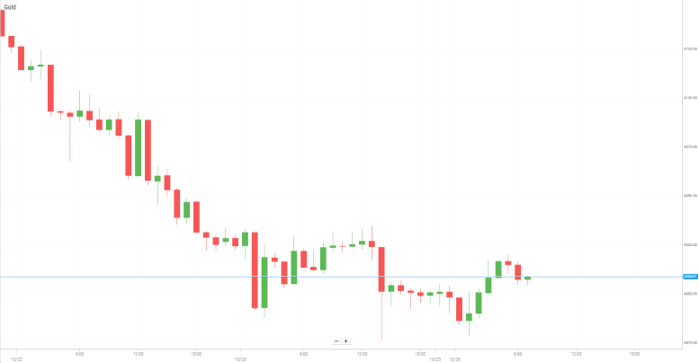
Gold (XAU/USD) snapped a two-day losing streak, clinging to modest intraday gains above the $4,000 per ounce psychological mark during early European trading on Monday. The precious metal found temporary support from lower U.S. Treasury yields, though follow-through buying remained constrained by firming bets for a December Fed rate hike and oil-driven global inflation fears. Over the previous week, non-yielding bullion suffered significant downward pressure, declining 4.05% as traders adjusted portfolios ahead of Wednesday's FOMC decision and Chair Kevin Warsh's press conference.
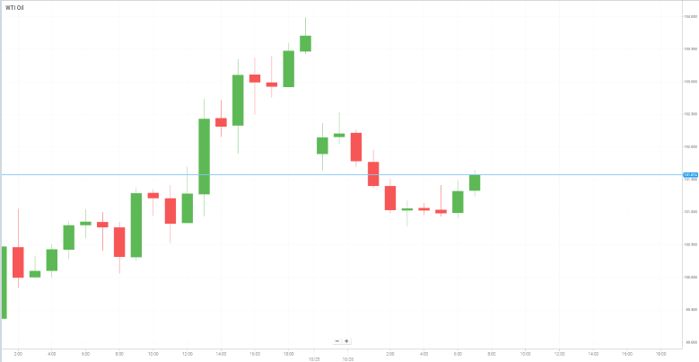
West Texas Intermediate (WTI Oil) opened the week on a weaker note, sliding below $100.50 per barrel during Asian hours on Monday as hopes for a temporary easing of Middle East hostilities prompted profit-taking following last week's 2.01% gain. The pull-back came after President Trump ruled out immediate military action against Iran. However, downside potential remained limited as ongoing Houthi strikes on Saudi Arabian infrastructure and potential post-election military action against Iranian energy assets kept the geopolitical risk premium firmly embedded across global energy markets.
Asian stock markets traded mostly lower on Monday, extending last week's sharp technology selloff as persistent doubts over artificial intelligence capital expenditure returns weighed on regional chipmakers. South Korea's KOSPI fell around 1.5%, building on Samsung Electronics' 18.55% weekly plunge, with the stock sliding further in Monday's session. In Japan, the Nikkei 225 dropped, pressured by losses in technology leaders including Tokyo Electron which slumped 11.37% over the previous week and lost another 3.5% on Monday.
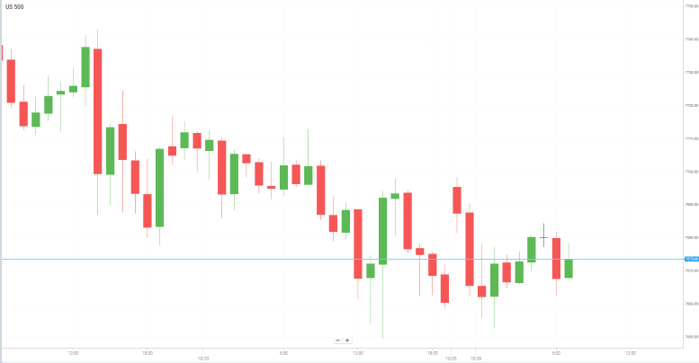
U.S. equity market futures steadied early Monday following two consecutive weeks of sharp technology-driven losses, as investors re-evaluated elevated AI infrastructure valuations and debt-funded capital expenditure plans. Last week, broad technology weakness saw Microsoft fall 0.86%, Amazon decline 0.78%, Nvidia drop 1.41%, and Alphabet plunge 5.85%. Market sentiment shifted toward defensive sectors, with Dow Jones futures outperforming as traders positioned ahead of major third-quarter corporate earnings releases.
Looking ahead, market participants are monitoring a heavy docket of economic data and corporate reports. Today, traders will monitor quarterly earnings from Verizon Communications and Welltower. On Tuesday, attention turns to earnings from Visa, Boeing, and Coca-Cola, ahead of Wednesday's pivotal FOMC Rate Decision, Statement, and Press Conference with Fed Chair Kevin Warsh, alongside earnings from Alphabet and Microsoft. On Thursday, focus shifts to the U.S. Advance Q3 GDP report, Core PCE inflation data, the ECB interest rate decision, and earnings from Amazon, Eli Lilly, Intel, and SanDisk, before concluding the week with the BOJ policy rate announcement on Friday.
The EUR/USD pair edged higher above 1.1200, trading near 1.1220 during Monday’s early Asian session as the Euro recovered some of its recent losses. However, concerns over France’s political instability, social unrest, and worsening public finances could limit further gains. Investors are also awaiting Germany’s IFO business climate reports, scheduled for release later on Monday.
Political tensions in France remain a key concern for the single currency. According to CNBC, protests over the rising cost of living and widening inequality turned violent for the second consecutive weekend. France’s Interior Ministry reported that approximately 410,000 people participated in demonstrations across several major cities, including Paris. The growing unrest, combined with concerns about the country’s deteriorating budget situation, could place renewed selling pressure on the Euro in the near term.
Meanwhile, investors are focusing on the European Central Bank’s (ECB) monetary policy decision scheduled for Thursday. The central bank is widely expected to keep its benchmark interest rate unchanged at 2.5% at its October meeting, although markets have largely priced in a rate hike before the end of the year, according to Reuters. Traders will closely examine the ECB’s policy statement for clues about the future interest rate path, particularly after President Christine Lagarde said in late September that a measured approach to managing inflation was appropriate.
In the United States, market participants broadly expect the Federal Reserve (Fed) to maintain its current interest rates at its upcoming October meeting on Wednesday, just days before the midterm elections. According to the CME FedWatch tool, markets are pricing in a 90.6% probability that the Fed will leave rates unchanged in October, while the probability of a rate hike in December stands at 79.4%. The ECB and Fed decisions are likely to influence near-term movements in EUR/USD, as traders assess the outlook for monetary policy on both sides of the Atlantic.
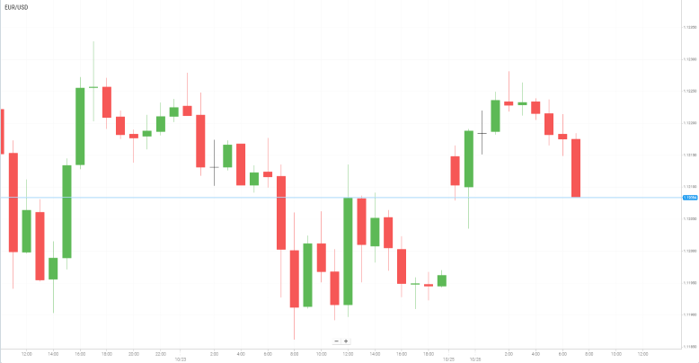
Gold recovered modestly on Monday, trading above the psychological $4,000 level during the early Asian session after snapping a two-day losing streak that had pushed prices to a three-month low on Friday. The rebound was supported by a softer US Dollar (USD) and declining US Treasury bond yields, which limited the greenback’s recovery from a three-week low. However, expectations of further Federal Reserve (Fed) monetary tightening and persistent inflation concerns continued to cap the upside potential for the non-yielding precious metal.
The US Dollar faced renewed pressure after US President Donald Trump ruled out immediate military action against Iran, prompting a modest pullback in crude oil prices. Meanwhile, recent comments from Federal Reserve officials suggested that there was no immediate urgency to raise interest rates. The sharp retreat in US Treasury yields from multi-year highs also provided some support for Gold, although uncertainty surrounding the inflation outlook and the Fed’s next policy moves kept investors cautious.
Geopolitical developments also remain an important factor for the precious metal. Crude oil prices recently climbed to their highest level since September 16 amid supply concerns linked to attacks in Saudi Arabia and tensions involving Iran. Yemen’s Iran-backed Houthi movement vowed on Sunday to continue attacks targeting Saudi Arabia’s King Khalid Airport in Riyadh, while stalled negotiations between Washington and Tehran continued to sustain geopolitical uncertainty. These risks could support demand for safe-haven assets, including Gold, although they may also limit deeper losses in the US Dollar and contribute to volatility across financial markets.
Investors are now turning their attention to a busy week of central bank decisions and key US economic releases. The Federal Open Market Committee (FOMC) is scheduled to announce its monetary policy decision on Wednesday, with traders closely monitoring the accompanying statement and comments from Fed Chair Kevin Warsh during the post-meeting press conference for clues about the future interest rate path.
Oil prices declined on Monday as diplomatic efforts to ease the US-Israeli conflict with Iran helped reduce concerns about further disruptions to global energy supplies. However, continued attacks by Yemen’s Iran-aligned Houthi movement on Saudi Arabia kept geopolitical risks elevated, limiting the extent of the market’s retreat.
Geopolitical tensions remained elevated over the weekend as the Houthis claimed responsibility for attacks targeting a Saudi airport and oil facilities on Saturday. Saudi Arabia subsequently reported intercepting additional missiles and drones on Sunday, reinforcing concerns about the vulnerability of critical energy infrastructure across the region.
Nevertheless, diplomatic initiatives offered some relief to oil markets on Monday. Qatari mediators travelled to Tehran on Sunday as part of efforts to de-escalate regional tensions in coordination with Washington. Reuters also reported that senior officials from Saudi Arabia, Turkey, and Pakistan were expected to meet Iranian counterparts in Tehran on Monday to discuss regional coordination. These developments raised hopes that diplomatic engagement could help prevent a further escalation of hostilities and reduce the risk of prolonged supply disruptions.
However, uncertainty surrounding Washington’s next move continued to cloud the outlook. US President Donald Trump told Fox News on Sunday that it was “getting to be decision time” on whether to reach an agreement with Tehran or intensify military action. Iranian Foreign Minister Abbas Araghchi, meanwhile, stated that the United States would not attempt another attack if rationality prevailed. The contrasting statements underscored the fragile nature of diplomatic efforts and left markets vulnerable to further volatility.
Overall, oil prices retreated as diplomatic efforts eased immediate fears of a broader regional conflict, following the sharp gains recorded last week. However, continued Houthi attacks, uncertainty surrounding US-Iran relations, risks to shipping through the Red Sea, and supply disruptions in Libya could limit further downside.
Wall Street’s major stock indexes closed lower on Friday, ending a volatile week as investors reassessed the outlook for artificial intelligence (AI) investments and positioned themselves ahead of a busy corporate earnings calendar and the Federal Reserve’s upcoming interest rate decision. Although technology shares showed signs of stabilization following the previous session’s sharp sell-off, broader market sentiment remained cautious amid concerns over rising AI infrastructure costs and the sustainability of investment spending.
Attention is now turning to quarterly earnings from major technology companies, including Alphabet, Microsoft, and Amazon, which are scheduled to report results this week. Their capital expenditure forecasts and commentary on AI-related investments will be closely scrutinized for indications of future growth prospects and profitability. Approximately one-third of S&P 500 companies are expected to report quarterly results this week, making corporate earnings a major driver of market sentiment.
Economic data added to concerns about the US outlook, with the University of Michigan reporting that consumer sentiment edged lower in October, approaching a record low as higher prices linked to the Middle East conflict weighed on household confidence.
Investors are also preparing for the Federal Reserve’s monetary policy announcement on Wednesday. The central bank is widely expected to leave interest rates unchanged, but market participants will closely examine policymakers’ statements for clues about the possibility of a rate increase in December. Interest rate expectations remain a key factor influencing equity valuations, particularly for technology companies whose growth prospects depend heavily on future earnings and financing conditions. The November 3 US midterm elections are another important focus, as the results will determine control of Congress and could influence the economic and regulatory outlook.
The materials contained on this document should not in any way be construed, either explicitly or implicitly, directly or indirectly, as investment advice, recommendation or suggestion of an investment strategy with respect to a financial instrument, in any manner whatsoever. Any indication of past performance or simulated past performance included in this document is not a reliable indicator of future results. For the full disclaimer click here.
Join iFOREX to get an education package and start taking advantage of market opportunities.
 A beginner's e-book
 $5,000 practice demo account
 A 12-part video course
 Trusted partner

 Featured partner
 By


