
Listed on 
 Years active
 English (Arabic)
 Chinese Simplified - 中文 (简体)
 Chinese Traditional - 中文 (繁體)
 English
 Japanese - 日本語
 Korean - 한국어 (대한민국)
 Portuguese - Português
 Russian - Русский
 Spanish - Español
 Thai - ไทย

 English (India)

Don't have an account?
Register via AppHave an account?
Login 23/11/2026 - 08:05 UTC
The United States Dollar Index (USDX) hesitated just below the 104.00 threshold after advancing +0.45% over the past week, supported by hawkish October FOMC meeting minutes and persistent inflation concerns. While CME FedWatch pricing indicates over a 90% probability of a December rate hike alongside further tightening into early 2027, traders trimmed bets on overly aggressive hikes after U.S. Treasury Secretary Scott Bessent warned against overtightening. Combined with softer bond yields and anxiety spilling over from the artificial intelligence stock selloff, the Greenback paused its four-week rally, though ongoing geopolitical risks in the Middle East continue to anchor safe-haven demand.
Global commodity and energy markets remained volatile as supply forecasts clashed with intensifying regional hostilities. Gold (XAU/USD) staged a fragile recovery above $3,600 early Monday, snapping a five-day losing streak after suffering a steep weekly rout of -9.10% to its lowest level since September 2025. Softer Treasury yields, easing oil-driven inflation fears, and safe-haven flows from equity market turbulence helped lift gold, though firming Fed rate expectations cap meaningful upside. Meanwhile, WTI Oil slumped below $83.00 toward $82.80 after falling -5.58% over the prior week, as International Energy Agency projections of a growing Q4 global supply surplus and recovering regional exports outweighed weekend Iranian attacks on Bahrain, Houthi strikes on Saudi Arabia, tanker incidents near Oman, and warnings from President Donald Trump that military strikes could resume in the new year.
Asian equity markets opened lower on Monday as renewed selling in semiconductor and technology shares deepened anxieties over AI valuations and debt-funded data-centre investments. Following Wall Street's sharp weekly downturn, major regional tech and internet leaders closed out a bruising week with steep losses, including Kioxia (-18.94%), Alibaba (-14.06%), SoftBank (-13.66%), Samsung Electronics (-11.36%), SK Hynix (-8.63%), Murata (-8.46%), and Meituan (-4.66%). With Japanese markets closed for a holiday, regional authorities moved to stem the rout—Taiwan tightened short-selling rules, South Korea prepared to activate its market stabilisation fund, and Chinese exchanges announced changes in margin requirements for stock purchases effective November 30.
U.S. equity futures rebounded sharply on Sunday evening after a punishing week pushed the main US equity indices into official correction territory, marking their steepest weekly losses in years. The broader selloff was driven by mounting skepticism over whether massive capital expenditures on AI infrastructure will generate sufficient returns, compounded by Jensen Huang's departure from Nvidia and Anthropic's weak post-IPO performance following its record debut. Major technology and hardware names registered severe weekly declines, including CoreWeave (-25.62%), Nvidia (-22.50%), AMD (-20.65%), and Dell (-19.29%), pushing Wall Street's fear gauge to its highest level since April 2025.
Looking ahead, market participants face a compressed, holiday-shortened trading schedule with U.S. markets closed on Thursday for Thanksgiving and operating on reduced hours Friday, a setup that could amplify price swings. Key macroeconomic focus will center on global flash PMIs, Australian CPI and Trimmed Mean CPI figures, and Wednesday's release of the U.S. Core PCE Price Index alongside Preliminary GDP data, while corporate earnings from Dell, Hewlett Packard Enterprise, Analog Devices, Autodesk, and Marvell will provide fresh insight into enterprise technology demand.
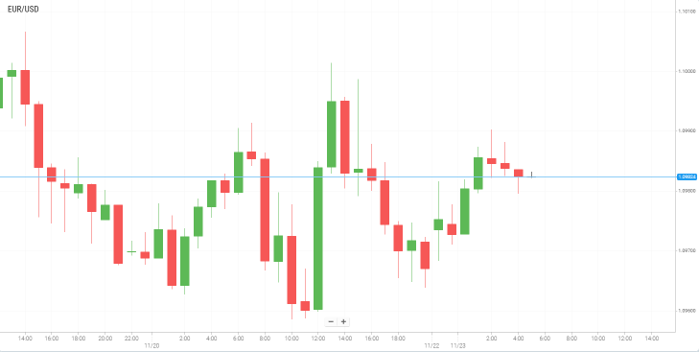
The EUR/USD pair starts the new trading week on a slightly positive note, recovering modestly during the Asian session but remaining below the key psychological level of 1.1000. Despite the uptick, the pair lacks strong bullish momentum and continues to trade close to its lowest level since May 2025, recorded last week. The prevailing strength of the US Dollar (USD) suggests that caution is still warranted before considering a sustained recovery in the Euro. The US Dollar remains supported by growing expectations that the Federal Reserve (Fed) could raise interest rates at its December policy meeting, with further monetary tightening anticipated into early 2027.
Middle East developments continue to influence market sentiment, with US President Donald Trump indicating on Sunday that he could consider resuming military action against Iran in the new year if diplomatic negotiations fail to produce an agreement. The US naval blockade of Iranian shipping remains in place, while Iran has intensified its attacks in recent days, targeting tankers in the Strait of Hormuz and bringing down US drones. These developments are sustaining geopolitical uncertainty and strengthening demand for the safe-haven Greenback.
Meanwhile, the Euro faces additional pressure from France's worsening fiscal and political situation. The country is experiencing a significant deadlock surrounding its 2027 budget, raising concerns about the economic and political stability of the Eurozone's second-largest economy. These domestic challenges are partially offsetting the increasingly hawkish stance of the European Central Bank (ECB), alongside growing expectations of a potential interest rate hike in December. Consequently, any recovery in the EUR/USD pair could attract renewed selling interest.
Looking ahead, traders will closely monitor the release of preliminary Purchasing Managers' Index (PMI) figures from the Eurozone and the United States later on Monday for fresh indications of economic conditions and potential short-term market direction.
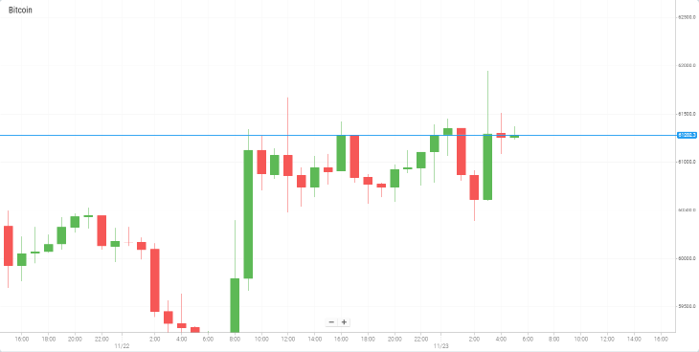
Bitcoin staged a modest recovery on Sunday, rising more than 1% to reclaim the $60,000 level after experiencing a sharp sell-off that pushed the world's largest cryptocurrency to its lowest level in nearly five months. However, the rebound remains limited, with investor sentiment still under pressure from declining mining profitability, growing regulatory uncertainty and newly disclosed network security vulnerabilities.
Despite the recovery, the cryptocurrency recorded a weekly decline of more than 6%, extending its losing streak and marking its longest sequence of weekly losses since May 2022. The recent downturn reflects a combination of rising expectations of further Federal Reserve monetary tightening, concerns about potential regulatory setbacks under a Democratic-controlled Congress and uncertainty surrounding Strategy's possible removal from MSCI indexes. Broader weakness across risk-sensitive assets, particularly following a significant sell-off in artificial intelligence-related stocks on Wall Street, has also weighed on cryptocurrency demand.
Additional concerns have emerged surrounding Strategy's substantial Bitcoin exposure. The company currently holds approximately 850,849 BTC, acquired at an average price of $75,452, leaving its holdings significantly underwater at prevailing market levels. Executive Chairman Michael Saylor has nevertheless reiterated his confidence in Bitcoin, emphasizing its fixed-supply characteristics and encouraging investors to maintain their long-term conviction despite the recent volatility..
Across the broader cryptocurrency market, most major digital assets also attempted a modest recovery alongside Bitcoin. Overall, Bitcoin's recovery above $60,000 offers some relief following the recent sell-off, but the broader market outlook remains fragile. Weakening mining economics, regulatory uncertainty, geopolitical and macroeconomic pressures, and concerns surrounding institutional Bitcoin exposure continue to weigh on investor confidence.
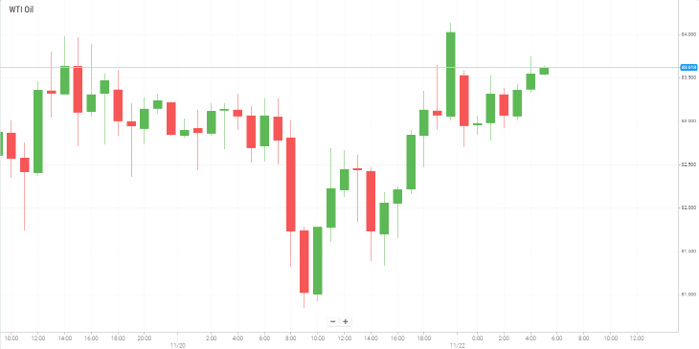
Oil prices moved lower at the start of the new trading week as mounting concerns over the global economic outlook and a sharp sell-off in equity markets weighed on demand expectations. However, escalating geopolitical tensions in the Middle East, particularly continued attacks on shipping routes in the Gulf and around the Strait of Hormuz, helped limit the downside.
Nevertheless, geopolitical developments continue to provide an important degree of support for oil prices. The unresolved US-Israeli conflict with Iran and the growing threat to energy transportation routes across the Middle East remain significant sources of uncertainty for global crude supplies. On Sunday, the Iran-aligned Houthi movement claimed responsibility for an attack on a Saudi Arabian oil refinery, while several additional attacks targeting commercial shipping in the Gulf and near the Strait of Hormuz were reported over the weekend.
Meanwhile, developments at the COP31 climate summit in Turkey have highlighted continued divisions among major economies over the future of fossil fuels. Negotiations collapsed on Sunday after participating nations failed to reach an agreement on including language concerning the phase-out of fossil fuels in the final declaration. Saudi Arabia and other major oil-producing countries reportedly opposed references to phasing out fossil fuels, arguing that these energy sources will continue to play an important role in the global economy for the foreseeable future. OPEC has similarly defended the continued role of fossil fuels in meeting global energy demand.
Looking ahead, attention will increasingly turn to the upcoming OPEC+ ministerial meetings scheduled for November 29, when member countries and their allies, including Russia, are expected to discuss the group's oil production strategy for 2027. Any indication of future production adjustments could have significant implications for global supply expectations and crude oil price dynamics.
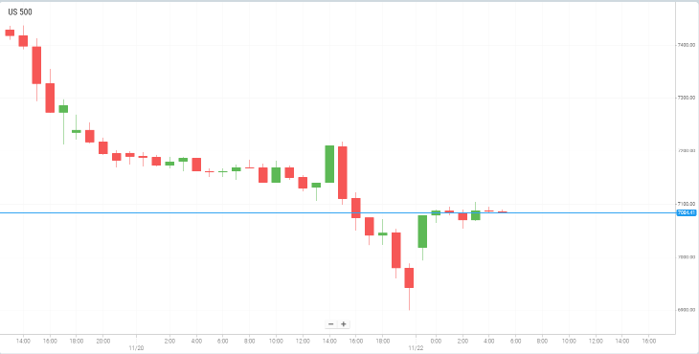
US stock futures rebounded sharply on Sunday evening following a turbulent week on Wall Street that pushed all three major equity indexes into correction territory. Despite the recovery in futures trading, investor sentiment remains fragile, with technology stocks and concerns surrounding the sustainability of the artificial intelligence (AI)
The deterioration in market sentiment has largely been driven by growing concerns over the sustainability of the AI investment boom. Investors are increasingly questioning whether the enormous capital expenditure directed towards data centres, advanced computing infrastructure and semiconductor technology will ultimately generate sufficient financial returns to justify current market valuations. These concerns have intensified following disappointing market performance surrounding Anthropic's high-profile debut, adding further pressure to technology and semiconductor stocks. Heavyweight Nvidia has also experienced substantial selling pressure, contributing to the broader weakness across the technology sector.
Looking ahead, market participants will be assessing whether the latest rebound in futures signals the beginning of a recovery or simply represents a temporary pause following the recent correction. The central question remains whether the sell-off has created attractive buying opportunities in fundamentally strong companies or whether investors are beginning a deeper reassessment of elevated valuations and future corporate earnings expectations.
The upcoming economic calendar could also play an important role in shaping market direction. Particular attention will focus on Wednesday's release of the October Personal Consumption Expenditures (PCE) Price Index, the Federal Reserve's preferred inflation measure. The figures could provide fresh insight into underlying inflationary pressures and influence expectations regarding the central bank's future interest rate decisions.
Corporate earnings will provide another important test of investor confidence, particularly across the technology and hardware sectors. Hewlett Packard Enterprise and Dell Technologies are among the companies scheduled to report results during the week, with investors likely to scrutinize earnings performance, forward guidance and commentary on demand for AI-related infrastructure.
The materials contained on this document should not in any way be construed, either explicitly or implicitly, directly or indirectly, as investment advice, recommendation or suggestion of an investment strategy with respect to a financial instrument, in any manner whatsoever. Any indication of past performance or simulated past performance included in this document is not a reliable indicator of future results. For the full disclaimer click here.
Join iFOREX to get an education package and start taking advantage of market opportunities.
 A beginner's e-book
 $5,000 practice demo account
 A 12-part video course
 Trusted partner

 Featured partner
 By


