
Listed on 
 Years active
 English (Arabic)
 Chinese Simplified - 中文 (简体)
 Chinese Traditional - 中文 (繁體)
 English
 Japanese - 日本語
 Korean - 한국어 (대한민국)
 Portuguese - Português
 Russian - Русский
 Spanish - Español
 Thai - ไทย

 English (India)

Don't have an account?
Register via AppHave an account?
Login 09/11/2026 - 08:19 UTC
The United States Dollar Index (USDX) faced headwinds and edged lower early Monday, hovering slightly above the 102.00 level as improving risk sentiment tempered safe-haven demand. The Greenback's pullback follows a robust performance late last week, where USDX gained +1.42% propelled by strong U.S. employment data. The U.S. Bureau of Labor Statistics reported that Nonfarm Payrolls (NFP) surged by 165,000 in October, blowing past consensus estimates of 65,000 and pushing the Unemployment Rate down to 4.1%. Stronger labor metrics reinforced market expectations that the Federal Reserve could maintain a hawkish policy stance, with CME FedWatch pricing indicating nearly an 80% probability of a December rate hike.
Global commodity and energy markets experienced downward pressure as geopolitical tensions showed signs of potential de-escalation. Gold (XAU/USD) climbed back above $4,100 per ounce, advancing about 1% on Monday and building on a strong weekly gain of +4.78% driven by safe-haven demand and political speculation surrounding the U.S. Congress. Meanwhile, WTI Oil fell roughly 1% toward $89.50 per barrel, continuing to digest its steep weekly drop of -11.85%. Crude prices softened after U.S. President Donald Trump indicated that fresh military strikes against Iran were "highly unlikely" if diplomatic negotiations and nuclear talks continued to progress positively, though ongoing regional frictions and missile interceptions near the Arabian Peninsula kept a risk premium alive.
The geopolitical and corporate landscape remained active as investors digested regional developments and upcoming macroeconomic data. President Trump is slated to meet with Qatar's Prime Minister at the White House to discuss ceasefires and nuclear talks. In corporate developments, artificial intelligence and chip infrastructure names drew intense market scrutiny following reports surrounding Nvidia CEO Jensen Huang, alongside upcoming high-profile earnings reports from companies such as CoreWeave, Cisco Systems, Rocket Lab, and Constellation Energy.
Asian equity markets rebounded strongly on Monday, tracking Wall Street's recovery as investors bought into beaten-down technology and semiconductor shares. Taiwan's Taiex led regional gains, aided by regulatory measures implemented by the financial commission to stabilize local markets. Major regional technology leaders registered significant weekly losses from the prior rout, including Kioxia (-38.76%), SK Hynix (-20.17%), Samsung Electronics (-16.33%), Tokyo Electron (-12.50%), and TSMC (-9.92%). Conversely, Chinese internet and e-commerce leaders rallied counter-trend, with Tencent (+9.04%) and Alibaba (+11.63%) posting strong weekly gains. The surge was driven by a sharp sector rotation out of high-valuation AI hardware names into deeply discounted, cash-generative Chinese digital platforms, alongside supportive domestic liquidity measures from the People's Bank of China.
U.S. equity markets attempted a recovery at the start of the week following Thursday's steep tech selloff and Friday's modest bounce, with stock index futures trading positively led by Dow futures. Last week's turbulence was heavily driven by political concerns surrounding potential regulatory oversight on data centers and artificial intelligence infrastructure from a Democrat-controlled Congress. Major corporate and technology names registered significant weekly movements, including CoreWeave (-15.73%), Cisco (-10.22%), Nvidia (-8.90%), and SpaceX (-0.43%).
Looking ahead, market participants are bracing for a data-heavy economic calendar focused on inflation metrics to determine the Federal Reserve's next policy path. Tuesday brings the crucial October Consumer Price Index (CPI) report, while Friday features the release of the Producer Price Index (PPI). Additional focus centers on corporate earnings reports from key AI infrastructure and technology providers throughout the week.
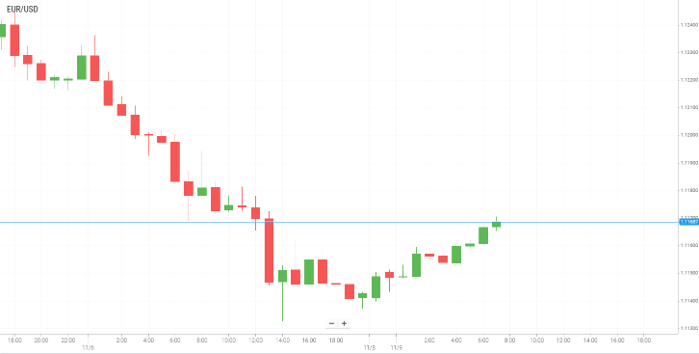
The EUR/USD pair gained ground after two consecutive sessions of losses, trading around 1.1150 during Monday’s Asian session. The Euro strengthened following hawkish comments from several European Central Bank (ECB) policymakers, including the heads of Germany’s and Italy’s central banks, who indicated that an interest rate hike in December could be increasingly likely.
Eurozone inflation climbed to a three-year high of 4% in October, mainly driven by rising energy costs, strengthening expectations of further monetary tightening. ECB President Christine Lagarde also stated on Thursday that the central bank is closely monitoring incoming economic data to assess whether another rate increase will be necessary next month.
Meanwhile, the US Dollar weakened despite growing expectations of another 25-basis-point interest rate increase by the Federal Reserve at its December 8–9 meeting. According to the CME FedWatch Tool, the probability of such a move has risen to nearly 80%, although the Greenback has so far struggled to benefit from these expectations.
However, stronger-than-expected US employment figures could provide support for the Dollar and limit further upside in EUR/USD. US Nonfarm Payrolls increased by 165,000 in October, significantly exceeding market expectations of 65,000 and improving on September’s reading of 60,000. At the same time, the Unemployment Rate edged down to 4.1%, compared with the forecast of 4.2%.
Looking ahead, market participants will closely monitor Tuesday’s US Consumer Price Index (CPI) report and Friday’s Producer Price Index (PPI) data for further clues about the Federal Reserve’s monetary policy outlook. These releases could influence expectations surrounding future interest rate decisions and determine the next directional move for the EUR/USD pair.
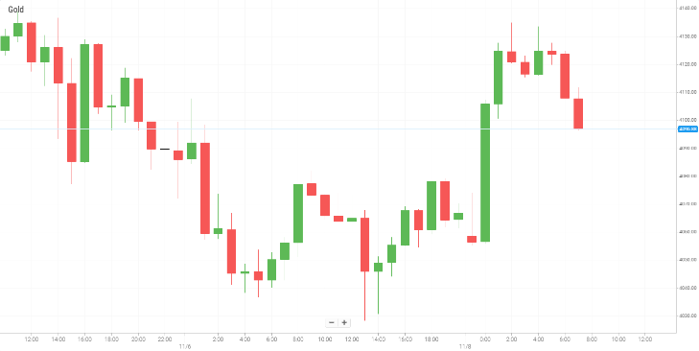
Gold prices recovered some of their recent losses, climbing above $4,080 during early European trading on Monday. The precious metal gained support from a weaker US Dollar and growing optimism surrounding potential diplomatic progress in the US-Iran conflict.
According to Reuters, US President Donald Trump is scheduled to meet Qatar’s Prime Minister at the White House on Monday at 17:00 GMT to discuss a possible ceasefire and the resumption of nuclear negotiations as the conflict with Iran continues. Hopes for a diplomatic resolution have supported demand for Gold amid uncertainty surrounding the geopolitical outlook.
Additional support for the precious metal comes from expectations that incoming Democrats will seek to limit further US involvement in the conflict. Democrats, who secured majorities in both the House and Senate, have strongly opposed Trump’s proposed $1.5 trillion defense budget. According to Bloomberg, they are reportedly more inclined to approve a budget closer to $1 trillion, reflecting concerns about continued military funding for the war against Iran.
However, Gold’s upside may remain limited following stronger-than-expected US employment data, which could support the US Dollar and increase pressure on the USD-denominated commodity. The stronger employment figures have reinforced expectations that the Federal Reserve may maintain higher interest rates for longer. Elevated interest rates generally reduce the attractiveness of non-yielding assets such as Gold by increasing the opportunity cost of holding the precious metal.
Overall, Gold remains supported by geopolitical developments and US Dollar weakness, although stronger economic data and expectations of tighter monetary policy could limit further gains in the near term.
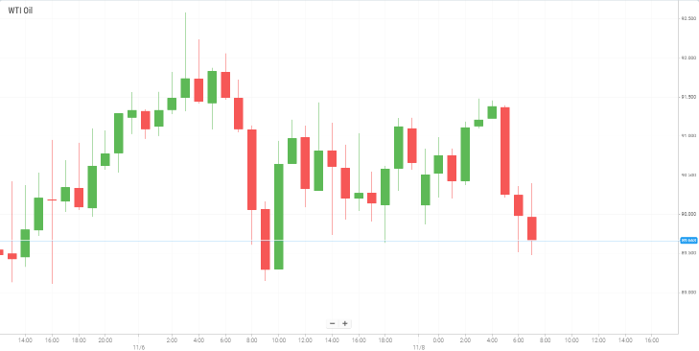
Oil prices moved lower on Monday after US President Donald Trump played down the possibility of further military strikes against Iran, although continued attacks on shipping near the Strait of Hormuz kept concerns over global supply disruptions in focus.
Market sentiment improved after Trump said on Sunday that he was highly unlikely to authorize further attacks on Iran as long as negotiations to end the conflict continued. However, reports of attacks on vessels in and around the Strait of Hormuz have maintained concerns about the security of one of the world's most important oil transportation routes.
Beyond geopolitical developments, growing concerns about an oversupply of crude oil are also weighing on prices. JPMorgan warned in a report published on Friday that recovering Middle Eastern production, increasing output from other producers and weaker demand could push global oil supply further above consumption. The bank estimated that the market surplus reached 1.1 million barrels per day in September and widened to 1.4 million barrels per day in October.
Separately, the Iran-aligned Houthi group claimed responsibility for an attack on Saudi Aramco's offices in Riyadh on Sunday. The incident reportedly caused damage to windows but resulted in no casualties, adding another layer of uncertainty to the regional security outlook.
Overall, oil prices remain under pressure as expectations of diplomatic progress between the United States and Iran reduce immediate geopolitical risk concerns, while growing global supply and weaker demand reinforce bearish market sentiment. Nevertheless, continued disruptions to shipping through the Strait of Hormuz could limit further declines and maintain a geopolitical premium in crude prices.
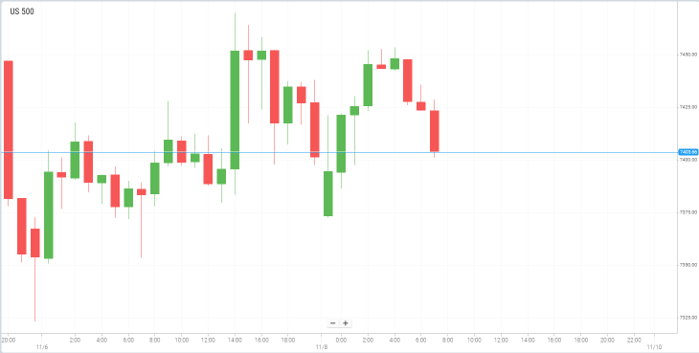
US stock index futures edged higher during Asian trading on Monday as investors assessed whether technology shares could extend their recovery following last week’s sharp selloff. Market participants are also turning their attention to upcoming US inflation data and earnings reports from companies closely linked to the artificial intelligence (AI) industry. The rebound followed Thursday’s sharp selloff while technology shares came under pressure partly due to concerns that the Democrats’ victories in the US midterm elections could result in tighter regulations on artificial intelligence development and data centre construction.
Nvidia is also expected to remain in focus after the company's board announced an independent investigation into reports that Chief Executive Jensen Huang had been targeted by a foreign intelligence operation. Separately, reports surrounding Huang have added further uncertainty and attracted investor attention.
Meanwhile, the economic calendar is dominated by upcoming inflation releases, with the October Consumer Price Index (CPI) scheduled for Tuesday and Producer Price Index (PPI) figures due on Friday.
On the corporate front, earnings from major AI infrastructure companies will provide additional insight into investment trends and demand across the technology sector. Cloud computing provider CoreWeave is scheduled to report its results on Tuesday, while semiconductor equipment manufacturer Applied Materials and networking company Cisco Systems are expected to release earnings on Thursday.
Overall, Wall Street futures are showing signs of recovery as investors cautiously return to technology stocks following last week's losses. However, the upcoming inflation reports, Federal Reserve rate expectations and corporate earnings from key AI-related companies are likely to determine whether the rebound can develop into a more sustained recovery.
The materials contained on this document should not in any way be construed, either explicitly or implicitly, directly or indirectly, as investment advice, recommendation or suggestion of an investment strategy with respect to a financial instrument, in any manner whatsoever. Any indication of past performance or simulated past performance included in this document is not a reliable indicator of future results. For the full disclaimer click here.
Join iFOREX to get an education package and start taking advantage of market opportunities.
 A beginner's e-book
 $5,000 practice demo account
 A 12-part video course
 Trusted partner

 Featured partner
 By


