
Listed on 
 Years active
 English (Arabic)
 Chinese Simplified - 中文 (简体)
 Chinese Traditional - 中文 (繁體)
 English
 Japanese - 日本語
 Korean - 한국어 (대한민국)
 Portuguese - Português
 Russian - Русский
 Spanish - Español
 Thai - ไทย
 English (India)
Don't have an account?
Register via AppHave an account?
Login 28/09/2026 - 07:00 UTC
The US Dollar Index (USDX) opened flat at around 101.10 during Monday's Asian trade, maintaining its resilience following a 0.81% gain last week. Greenback demand remains supported by persistent hawkish expectations surrounding the Federal Reserve, with markets currently pricing in nearly a 68% to 70% probability of another 25 bps rate hike at the October FOMC meeting. Elevated US Treasury yields—with the 10-year yield holding above 5% and the 30-year yield near 5.51%—continue to underpin the greenback alongside safe-haven interest triggered by broader Middle East conflict concerns.
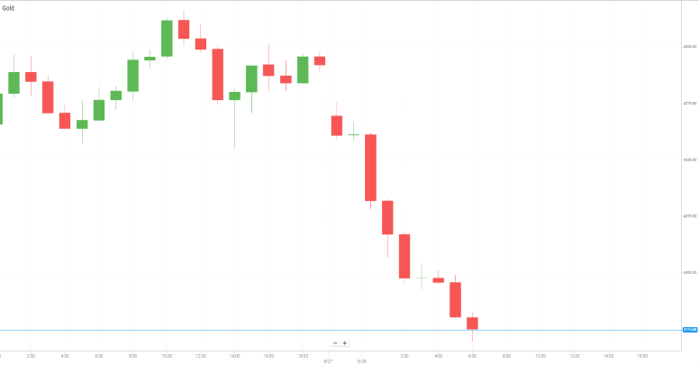
Gold came under severe selling pressure at the start of the week, dropping below the $4,200 mark to hit its lowest level since August 5 after falling 1.96% last week. Rising bond yields and expectations of further Fed policy tightening have dampened demand for non-yielding bullion. While ongoing US-Iran tensions and Houthi attacks in the region continue to offer an underlying safe-haven bid, strong US Dollar momentum and elevated interest rate expectations remain dominant headwinds for XAU/USD.
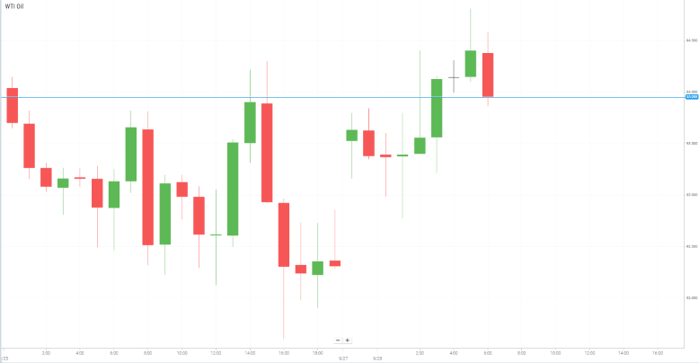
WTI Crude Oil extended its upward momentum, trading near $93.05 after posting a 7.56% decline last week, while Brent Crude jumped over 2% above $106 per barrel. Upside pressure resurfaced after US President Donald Trump rejected an Iranian proposal to end the conflict and reopen the strategic Strait of Hormuz, maintaining high geopolitical risk premiums across energy markets. Heightened inflation concerns stemming from climbing crude prices are adding further fuel to expectations that central banks will maintain restrictive monetary policy.
Asian stock markets traded mostly lower on Monday, dragged down by surging energy prices, multi-year high bond yields, and sharp sell-offs across the semiconductor sector. Concerns over a potential deceleration in AI infrastructure spending emerged following reports that OpenAI paused training for select advanced models. Major regional names posted notable weekly and session movements: SK Hynix fell nearly 5% on Monday after gaining 0.98% last week, Samsung Electronics dropped nearly 5% following a 9.61% weekly rally, Kioxia Holdings slipped 2.5% after a 4.63% gain last week.
US equity futures pointed to a weaker open as rising Treasury yields and tech-sector caution weighed on sentiment ahead of crucial macroeconomic data releases. Megacap tech and semiconductor names remain in focus following last week's performance, where Nvidia gained 1.35% and Meta surged 12.86%. Investors are monitoring whether AI agent developments can sustain sector momentum against the backdrop of rising discount rates and elevated energy costs.
Looking ahead, market participants face a data-heavy week, keying in on incoming releases for US Core PCE Price Index m/m (forecast 0.3% vs. 0.2% previous), Final GDP q/q, ADP Employment Change, JOLTS Job Openings, ISM Manufacturing PMI, and Friday’s Non-Farm Employment Change (forecast 98K vs. 162K previous) alongside the Unemployment Rate. Focus will also center on the Reserve Bank of Australia (RBA) Rate Statement and cash rate decision, ongoing diplomatic and military updates surrounding the Strait of Hormuz, and corporate earnings releases from Carnival Corp, Micron, Accenture, and Nike.
The EUR/USD pair edged lower to around 1.1380 during early Asian trading on Monday, pressured by a more hawkish Federal Reserve (Fed) stance and heightened tensions in the Middle East. Investors are also looking ahead to Germany’s Retail Sales and Consumer Price Index (CPI) data due on Wednesday for fresh direction.
Several Fed officials struck a hawkish tone last week. Cleveland Fed President Beth Hammack said on Friday that persistently elevated inflation could lead Americans to become accustomed to higher prices, warning that the central bank cannot allow that to become the norm. Philadelphia Fed President Anna Paulson also said that “some modest further tightening may be warranted.”
Meanwhile, escalating tensions in the Middle East could increase demand for safe-haven assets and further support the Greenback. US President Donald Trump said on Sunday that he expects the conflict with Iran to be resolved “very soon,” while also suggesting that further military strikes before the midterm elections remain possible.
Iran, meanwhile, has maintained that it will reopen the strategically important waterway only if its conditions are met. A senior Iranian military official also reiterated the country’s readiness to continue fighting, adding to uncertainty in financial markets and potentially supporting demand for safe-haven currencies.
With monetary-policy expectations still sensitive to incoming economic data, Germany’s upcoming inflation and retail-sales figures could provide fresh clues about the ECB’s policy path and influence the EUR/USD outlook.
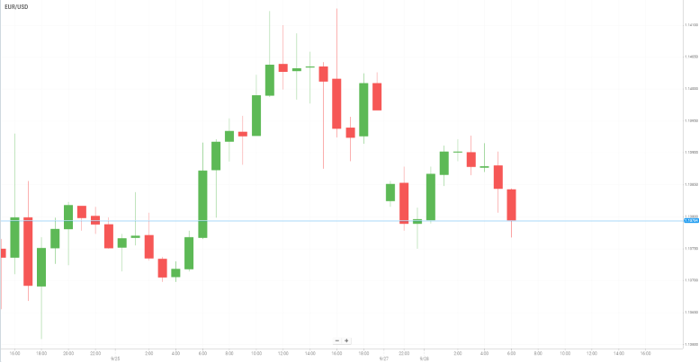
Gold came under renewed selling pressure at the start of the new week, falling below the $4,200 level and reaching its lowest point since August 5 during the Asian session. The precious metal remains under pressure amid a bearish fundamental backdrop, with rising expectations for another Federal Reserve (Fed) rate hike and elevated US Treasury yields weighing on demand for the non-yielding asset.
Higher US yields and a stronger US Dollar typically create headwinds for Gold, as the precious metal does not offer interest income.
Geopolitical uncertainty is also supporting the US Dollar and adding to pressure on Gold. In the latest developments surrounding the Middle East, US President Donald Trump rejected an Iranian proposal on Saturday to immediately reopen the Strait of Hormuz in exchange for meeting Tehran’s conditions and ending hostilities. Trump said on Sunday that additional military strikes against Iran could take place before the US midterm elections.
Meanwhile, Houthi forces continued attacks on Saudi Arabia, while Yemeni government forces intensified operations against the Iran-backed group with multiple air and ground strikes. The developments have raised concerns about a broader regional conflict, supporting oil prices and reinforcing demand for the safe-haven US Dollar.
Looking ahead, traders will focus on speeches from Federal Open Market Committee (FOMC) members and developments in the Middle East for fresh direction. The economic calendar also features the US Personal Consumption Expenditures (PCE) Price Index and final second-quarter Gross Domestic Product (GDP) data on Wednesday, followed by the closely watched Nonfarm Payrolls (NFP) report on Friday. These releases could influence expectations for the Fed’s next policy move and provide fresh momentum for the US Dollar and Gold.
Oil prices rose more than 1% on Monday after Iran said it would not ease its conditions for reopening the Strait of Hormuz, following US President Donald Trump’s rejection of Tehran’s proposal. The standoff has heightened uncertainty over when traffic through the strategically important oil shipping route will return to normal.
Under Iran’s proposal, the Strait of Hormuz could reopen within seven days while broader negotiations continue, provided Washington lifts its naval blockade, reduces military pressure, eases sanctions on Iranian oil exports and agrees to a ceasefire. Tehran has maintained that it remains committed to these conditions despite Trump’s rejection of the proposal.
The Strait of Hormuz remains a key focus for oil markets, as roughly one-fifth of global oil and liquefied natural gas supplies passed through the waterway before the conflict began. Shipping activity has fallen sharply since the escalation, raising concerns about potential disruptions to global energy supplies.
Supply risks have also increased as Iran-backed Houthi forces in Yemen stepped up attacks on Saudi Arabia and commercial shipping in the Red Sea. Saudi Arabia said on Saturday that it had intercepted two ballistic missiles and two drones launched by the Houthis, following the interception of six missiles targeting areas near Taif and Yanbu in recent days.
The disruptions have forced Gulf oil producers to explore alternative routes for transporting crude, adding to concerns over the availability of supplies. However, there have been signs that some shipments are still moving through the Strait at a higher rate.
Markets are also closely monitoring refined-product supplies. Diesel prices in Europe and the United States have climbed to record levels as disruptions to crude and refined-product exports from the Middle East and Russia have tightened fuel markets.
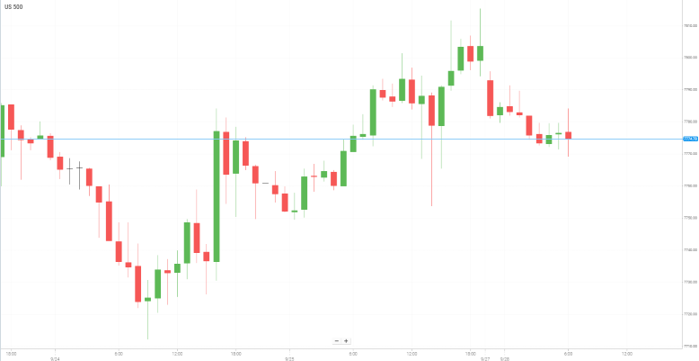
US stocks ended higher on Friday, recovering from early volatility as easing oil prices provided some relief to markets. A pullback in the sell-off across US Treasury bonds, particularly at the shorter end of the curve, also helped support sentiment.
Despite a volatile week marked by shifting Federal Reserve rate expectations, geopolitical uncertainty, elevated oil prices and renewed strength in artificial intelligence stocks, all three major US equity indexes finished the week in positive territory. The US 500 recorded its strongest daily performance since early August, supported in part by growing interest in Meta Platforms’ new personal AI agent, Muse.
Meta shares have surged more than 30% so far in September and nearly 14% this week. The company officially launched Muse on September 8, and the AI agent has quickly gained popularity among consumers, reaching the top of Apple’s App Store rankings.
The growing adoption of AI agents has also raised questions about their potential impact on industries such as travel, telecommunications and ride-hailing. Financial companies have also faced concerns as AI tools become increasingly capable of tasks such as analyzing bank statements, transferring funds and negotiating fees.
Despite the resilience of US equities, the sharp sell-off in Treasury bonds has remained a major concern for investors. Longer-dated Treasury yields climbed to their highest levels in years, with the 10-year yield reaching its highest level since June 2007 and the 30-year yield touching its highest since June 2004.
Markets have also been watching developments between US President Donald Trump and Chinese President Xi Jinping. China remains Iran’s largest trading partner and an important buyer of Iranian crude, making the issue particularly relevant for global energy markets.
The materials contained on this document should not in any way be construed, either explicitly or implicitly, directly or indirectly, as investment advice, recommendation or suggestion of an investment strategy with respect to a financial instrument, in any manner whatsoever. Any indication of past performance or simulated past performance included in this document is not a reliable indicator of future results. For the full disclaimer click here.
Join iFOREX to get an education package and start taking advantage of market opportunities.
 A beginner's e-book
 $5,000 practice demo account
 A 12-part video course
 Trusted partner
 Featured partner
 By
By 


